
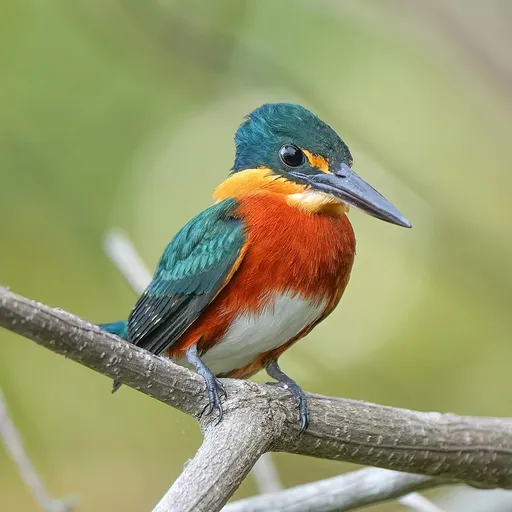
American Pygmy Kingfisher
Chloroceryle aenea
Least Concern
Overview
The American pygmy kingfisher, Chloroceryle aenea, is a small bird in the family Alcedinidae classified as a 'water kingfisher'. It is native to the American tropics, ranging from southern Mexico through Central America into most of South America, excluding Chile and Uruguay.
Identification
- Small bird approximately 13 cm long with a typical kingfisher shape, featuring a shaggy crest and a long, heavy bill.
- Males display a dark glossy green head and upperparts with a golden wash and a narrow rufous collar, while females have a dark green band across the upper breast.
- Underparts are largely rufous with a white center on the breast and undertail coverts; the bill is black with pale yellow at the base of the mandible, and legs are pinkish to light gray.
- Vocalisations include a weak, repeated 'tik' or 'dzit, tsweek' sound, sometimes delivered as a fast rattle, and a song described as a series of musical chirps.
Habitat
This species inhabits dense forest environments, specifically favouring small streams, rivers, pools, swamps, and tidal channels in mangroves. It avoids open landscapes and is found at elevations ranging from sea level to 2,600 m.
Diet
The American pygmy kingfisher hunts by diving into water from a low perch to catch small fish, tadpoles, frogs, and large insects such as damselflies. While there are unconfirmed reports of it catching insects on the wing, its primary foraging method is aerial diving from perches.
Did you know?
Both members of a breeding pair work together to excavate a burrow, typically 30 to 40 cm long, in river banks, road cuttings, gravel pits, arboreal termitaria, or the root balls of fallen trees. The species' scientific epithet aenea is derived from the Latin aeneus, meaning 'of a bronze colour'.
Sources
- Wikipedia · CC BY-SA 4.0
- Wikidata · CC0 1.0