
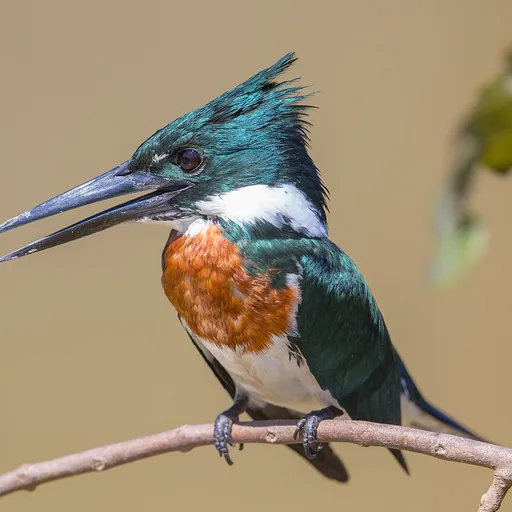
Amazon Kingfisher
Chloroceryle amazona
Least Concern
Overview
The Amazon kingfisher (Chloroceryle amazona) is a species of water kingfisher found in the lowlands of the American tropics. It is a large, sedentary bird classified as Least Concern by the IUCN, though its population is believed to be decreasing.
Identification
- Approximately 30 cm long with a shaggy crest and a long, heavy black bill that has pale yellow at the base of the mandible.
- Adult males feature dark bronzy green upperparts divided by a white collar, with a rich rufous breast and white belly; females lack the rufous breast and have green extending across the chest.
- Legs and feet are dark grey, and juveniles possess buff spots on the upperwing coverts along with a large yellow patch on the bill.
- Vocalisations include a loud, harsh 'tek' or 'klek', a staccato 'chrit', frog-like calls, and an accelerating series of clear notes described as 'see see see'.
Habitat
It inhabits large slow- and fast-flowing rivers, as well as the wooded shores of lakes and freshwater lagoons, occasionally appearing in brackish lagoons, mangroves, and tidal estuaries. The species favours open landscapes over dense forests and is found from southern Mexico through Central America to northern Argentina, generally occurring below 1,200 m but reaching up to 2,500 m in Venezuela.
Diet
The bird hunts from a perch by diving into water to catch prey, occasionally hovering before the dive. Its diet consists mostly of fish, particularly those from the family Characidae, and crustaceans.
Did you know?
Both members of a pair excavate a slightly inclined burrow in a river bank for nesting, typically up to 1.6 m long, with the female handling most incubation at night and the male taking over during the day.
Sources
- Wikipedia · CC BY-SA 4.0
- Wikidata · CC0 1.0