
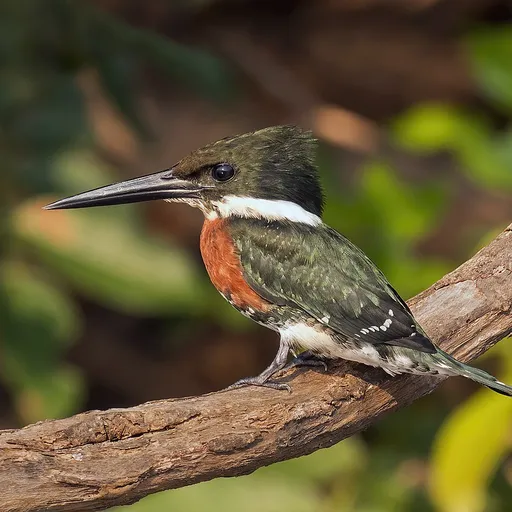
Green Kingfisher
Chloroceryle americana
Least Concern
Overview
The green kingfisher (Chloroceryle americana) is a species of water kingfisher in the subfamily Cerylinae of the family Alcedinidae. It is found from southern Texas in the United States south through Central America, and in every mainland South American country except Chile. Its IUCN Red List category is Least Concern.
Identification
- Approximately 20 cm (8 in) long, weighing between 35 and 40 g, with females generally larger than males.
- Green upperparts with two or more rows of white spots on the flight feathers; underparts are mostly white with green spots on the sides and flanks.
- Long, heavy black bill with some horn colour at the base of the mandible; dark grey legs and feet.
- Males possess a white collar and rufous breast, whereas females have a buffy throat and breast with a band of green speckles across the chest.
- Vocalisations include a sound resembling the striking of two pebbles together and a harsh, buzzy scold described as tsheersh, tseelp or zchrrk.
Habitat
This species inhabits wooded shorelines of streams, freshwater ponds, and lakes, favouring still or slow-moving water. It requires low vegetation for hunting perches but generally prefers relatively open habitat rather than dense forest. It is a year-round resident throughout its range.
Diet
The green kingfisher usually hunts from a perch, diving into the water to catch prey that mostly consists of small fish, along with crustaceans such as shrimp and aquatic or terrestrial insects. It shifts perches after each foray and occasionally hovers from as high as 6 m (20 ft) before diving.
Did you know?
Both members of a pair excavate a nest burrow in an earthen bank, which can be up to 1 m (3 ft) long and concludes with a small nest chamber at the end. The incubation period lasts 19 to 21 days, with the female usually incubating at night and the parents alternating during the day.
Sources
- Wikipedia · CC BY-SA 4.0
- Wikidata · CC0 1.0