
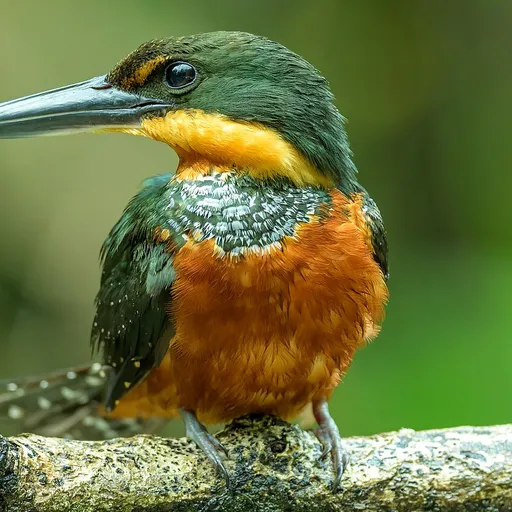
Green-and-rufous Kingfisher
Chloroceryle inda
Least Concern
Overview
The green-and-rufous kingfisher is a species of water kingfisher found in the American tropics, ranging from Nicaragua through Panama and across most mainland South American countries. It is classified as Least Concern on the IUCN Red List, with an estimated population of at least half a million mature individuals that is currently decreasing.
Identification
- Approximately 24 cm in length with a typical kingfisher shape, featuring a somewhat shaggy crest and a long, heavy black bill with pale yellow at the base of the mandible.
- Legs and feet are pinkish to dark grey; males possess glossy green upperparts with white-tipped coverts and a pale yellowish collar, while females have a wide green breast band with white speckles and heavier spotting.
- Underparts are rich dark rufous with a buffy rufous throat and yellow-buff chin, though juveniles resemble females with even heavier spotting on the upperparts.
- Song consists of thin, high-pitched 'week week week' notes, accompanied by calls such as 'chip-chip-chip', a hard rolling 'drrrt', and a crackling 'trit-trit-trit'.
Habitat
This species inhabits streams, rivers, forested swamps, and mangroves, favouring densely vegetated banks and shunning open shorelines. It ranges in elevation from sea level up to 400 m, with its distribution covering southeastern Nicaragua through the Caribbean slope of Costa Rica and into South America, excluding Argentina, Chile, and Uruguay.
Diet
The bird forages by hunting from a low, shaded perch, diving into the water to catch prey. Its diet consists of small fish from families such as Characidae, Cichlidae, and Cyprinodontidae, as well as crabs, shrimps, and aquatic insects.
Did you know?
Although the scientific name Chloroceryle inda contains the epithet 'inda', which is derived from the Latin word for India, the type locality was mistakenly recorded as 'India occidentali' by Carl Linnaeus, who actually based his description on a bird from Guiana.
Sources
- Wikipedia · CC BY-SA 4.0
- Wikidata · CC0 1.0