
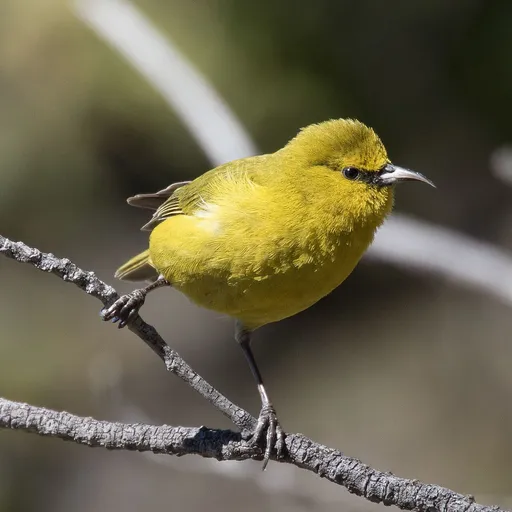
Hawaii Amakihi
Chlorodrepanis virens
Least Concern
Overview
The Hawaiʻi ʻamakihi, also known as the common ʻamakihi, is a species of Hawaiian honeycreeper found on several Hawaiian islands. It is considered the most adaptable of the native forest birds and has shown the least impact from habitat changes among its peers.
Identification
- A small bird measuring about 10 cm in length with yellow-green plumage.
- Features a small black bill that is 1.3 cm long and brown eyes with black pupils.
- The primary song consists of a rapid trill.
Habitat
Found on the Big Island, Maui, and Molokaʻi, with the species formerly present on Lāʻi until 1976. It inhabits all types of habitat, ranging from dry māmane forests to mesic and wet forests, at elevations from sea level to 8,000 feet. On Maui, the bird has also successfully established itself in forests of introduced pines, cypresses, and firs.
Diet
This bird possesses a tubular tongue used to drink nectar from flowers such as ʻōhiʻa lehua, ʻākala, and māmane. It also sucks juice from fruits when necessary and hunts for spiders and insects among trees and shrubs.
Did you know?
The Hawaiʻi ʻamakihi is suspected of evolving resistance to diseases such as avian malaria, contributing to its status as one of only two Hawaiian honeycreepers listed by the IUCN as being of least concern.
Sources
- Wikipedia · CC BY-SA 4.0
- Wikidata · CC0 1.0