
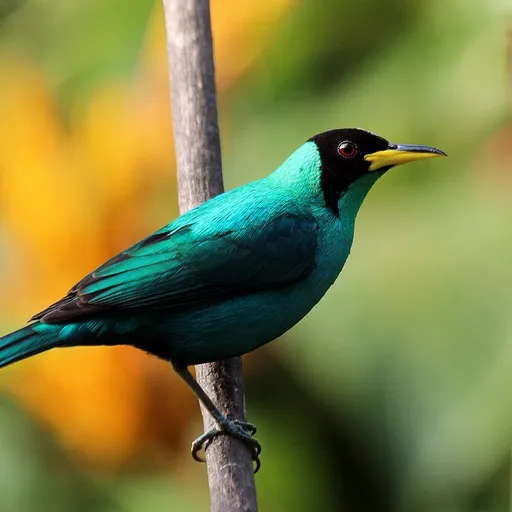
Green Honeycreeper
Chlorophanes spiza
Least Concern
Listen
XC242358 · Niels Krabbe · Esmeraldas: 7 km WNW Lita, Ecuador · CC BY-SA 4.0
Overview
The green honeycreeper (Chlorophanes spiza) is a small bird in the family Thraupidae, native to the tropical New World. It ranges from southern Mexico through Central America to Brazil, and is also found on Trinidad. The species is currently assessed as being of Least Concern by the IUCN Red List.
Identification
- Size approximately 13 cm long with a slender, slightly decurved bill.
- Sexually dimorphic plumage: adult males display a deep black head and glossy viridian green body, while females are grass-green above and paler green below.
- Bright reddish brown irises and gray legs with distinctive yellow toe pads.
- Song is seldom heard but described as a scratchy, high-pitched 'tst tst CHIT' followed by rapid chittering.
Habitat
This species inhabits the interior and edges of both primary and secondary humid forests, primarily utilising the canopy though it descends to lower levels at forest edges. In Brazil, it occurs in both terra firme and várzea forests, ranging in elevation from sea level up to 1,500 m, though higher elevations are reached in parts of Colombia and Ecuador.
Diet
The green honeycreeper feeds primarily on fruit, supplemented by smaller amounts of nectar and arthropods. It forages singly, in pairs, or as part of mixed-species flocks, often taking insects from fruiting trees but occasionally catching them in mid-air.
Did you know?
The genus name Chlorophanes is derived from Ancient Greek words meaning 'green' and 'showing', directly referencing the bird's vibrant colouration. Additionally, the 'purplish honeycreeper', known only from a single type specimen, is now believed to be an intergeneric hybrid between the green honeycreeper and either the red-legged honeycreeper or the blue dacnis.
Sources
- Wikipedia · CC BY-SA 4.0
- Wikidata · CC0 1.0