
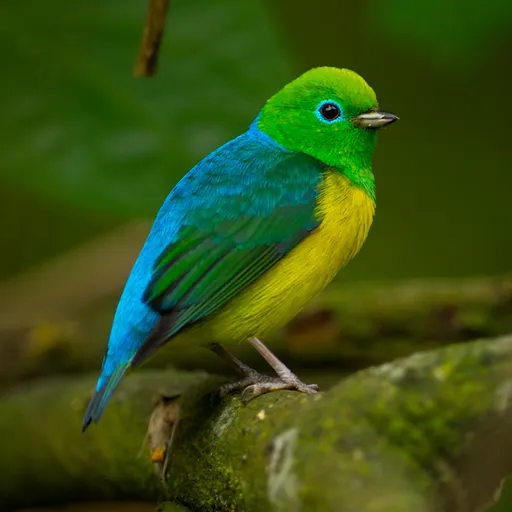
Blue-naped Chlorophonia
Chlorophonia cyanea
Least Concern
Listen
XC1090047 · Rosa Elena Albornoz @rosaelena_naturaleza · San Antonio De Los Altos (near Parroquia Macarao), Los Salias, Miranda, Venezuela · CC0 1.0
Overview
The blue-naped chlorophonia, Chlorophonia cyanea, is a species of small passerine bird in the finch and euphonia family, Fringillidae. It is a resident of mainland South America, found in every country except Chile, French Guiana, Suriname, and Uruguay, and is assessed as Least Concern by the IUCN.
Identification
- Size and shape: A chunky, short-tailed bird approximately 11 cm (4.3 in) long and weighing 11 to 15 g, with a stubby blackish bill and dark gray legs.
- Male plumage: The nominate subspecies features a glistening emerald-green head and chest, a bright turquoise-blue eye-ring, and blue upperparts with a brighter blue rump, while the breast, belly, and vent are bright yellow.
- Female plumage: Duller and plainer than males, with green head and upperparts, a thin blue collar on the nape, and dull greenish-yellow underparts, retaining the blue eye-ring.
- Song: Described as a choppy series of call notes mixed with liquid whistles, short warbles, and piercing notes, accompanied by calls such as a descending, whistled heu or seeu and a nasal, mechanical enk or dit.
Habitat
The species primarily inhabits the interior, edges, and clearings of humid to wet foothill and montane forests, as well as mature secondary forest. Its range spans from southeastern Brazil through Paraguay and Argentina to the Andes of Colombia, Ecuador, Peru, and Venezuela, and includes the isolated Sierra Nevada de Santa Marta in northern Colombia. Elevation ranges vary by location, typically between 500 m and 2,500 m (1,600 ft and 8,200 ft) across its distribution.
Diet
The blue-naped chlorophonia feeds almost exclusively on fruits, with a notable preference for mistletoe (Loranthaceae) fruits, though it occasionally includes insects. It forages in pairs, family groups, or small flocks of up to 12 individuals, typically within the middle to upper levels of the forest where it remains inconspicuous. Most fruits are obtained by reaching or leaning while perched.
Did you know?
Despite its current placement in the finch family, the blue-naped chlorophonia was originally described in 1822 as Pipra cyanea, a name that mistakenly identified it as a member of the manakin family.
Sources
- Wikipedia · CC BY-SA 4.0
- Wikidata · CC0 1.0