
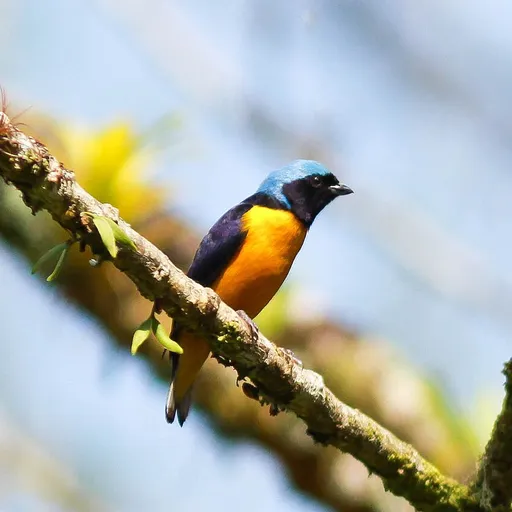
Golden-rumped Euphonia
Chlorophonia cyanocephala
Listen
XC242599 · Niels Krabbe · Pichincha: La Buena Esperanza, Tumbaco, Ecuador · CC BY-SA 4.0
Overview
The golden-rumped euphonia, Chlorophonia cyanocephala, is a small passerine bird in the family Fringillidae. It is found throughout mainland South America, with the exception of Chile, and was historically present on the island of Trinidad.
Identification
- About 11 cm long and 15 to 16 g, with a sexually dimorphic appearance where males have a bright turquoise-blue crown and nape, while females have a tawny or buff forehead.
- Males feature black heads, a purplish to dark blue gloss on the black mantle and back, and golden-yellow rumps, whereas females are predominantly olive-green.
- Both sexes possess a blackish bill with a blue-gray base, dark brown irises, and dusky gray legs.
- Vocalisations include a fast stream of twittery and squeaky notes mixed with low-pitched 'chup' sounds, alongside soft, descending whistled calls.
Habitat
This species inhabits a variety of open landscapes, including secondary forest, forest edges, disturbed areas, and shade coffee plantations. Its distribution is disjunct, occurring across South America from southern Colombia to northwestern Argentina, with distinct subspecies found in Venezuela, Ecuador, and eastern South America.
Diet
The golden-rumped euphonia feeds almost entirely on fruit, with a particular preference for mistletoe berries, and is believed to include insects in its diet. It forages in pairs or small groups and rarely joins mixed-species feeding flocks.
Did you know?
The species has a complicated taxonomic history, having been originally described in 1819 as Pipra cyanocephala due to a mistaken identification as a manakin before being reclassified into its current genus. It also serves as an important disperser of mistletoe seeds.