
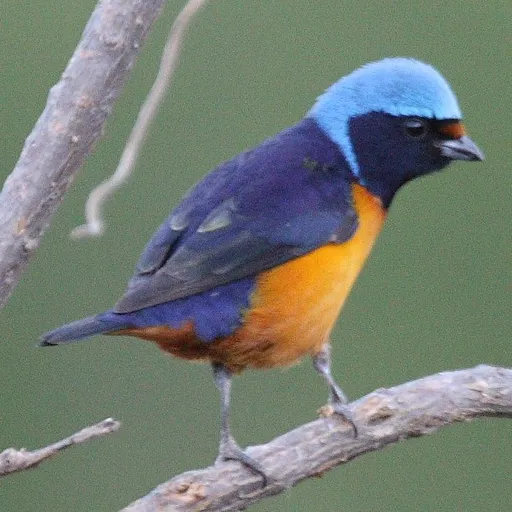
Elegant Euphonia
Chlorophonia elegantissima
Overview
The elegant euphonia (Chlorophonia elegantissima), also known as the blue-hooded euphonia, is a small passerine bird in the family Fringillidae. It is characterised by a highly disjunct distribution across Mexico and Central America and is generally considered a resident species, though some northern populations migrate south in winter.
Identification
- Males feature a rufous forehead, a bright turquoise-blue crown and nape, and glossy purplish-black upperparts, with tawny-orange underparts.
- Females have a rufous forehead and sky-blue crown, but possess olive-green upperparts and yellowish-olive underparts, making them duller than males.
- The species is sexually dimorphic and measures approximately 10 cm in length, weighing between 13 and 17 g.
- Song consists of a rapidly delivered liquid warble lasting up to several minutes, interspersed with chatters, buzzes, and clear whistles.
Habitat
Found in pine-oak, evergreen, and secondary forests within the upper tropical and subtropical zones. The species favours trees bearing mistletoe and typically occupies elevations between 1,000 and 2,500 m, although ranges vary by region from 500 m in Mexico to 3,050 m in northern Central America.
Diet
The elegant euphonia feeds almost exclusively on small berries, with a particular preference for those of mistletoe. Foraging occurs in pairs or flocks of up to ten individuals that roam in search of trees with ripe fruit.
Did you know?
The species has a complicated taxonomic history, having been originally described in 1838 as a manakin before being reassigned to the genus Euphonia and later to Chlorophonia.