
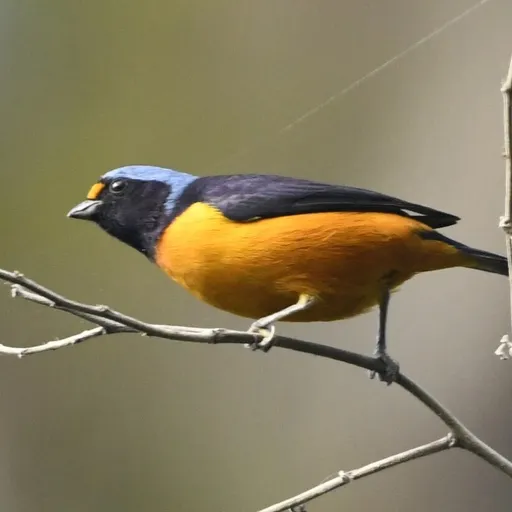
Hispaniolan Euphonia
Chlorophonia musica
Overview
The Hispaniolan euphonia (Chlorophonia musica) is a small passerine bird in the finch family Fringillidae. It is endemic to the Caribbean island of Hispaniola, where it inhabits both the Dominican Republic and Haiti, as well as the satellite island of Gonâve.
Identification
- Males feature a tawny yellow forehead, sky blue crown, blackish-violet head, and rich tawny yellow underparts.
- Females are more subdued, with olive-green upperparts, a turquoise crown, and pure yellow belly and undertail coverts.
- Song consists of a trilling, tinkling 'tuc-tuc-tuc' sequence lasting up to 20 minutes, punctuated by sharp whistles.
- Calls include a plaintive whistle often followed by soft 'tuk-tuk' or 'ee-oo-tuk-tuk' sounds.
Habitat
Found across Hispaniola and Gonâve Island, the species ranges from sea level to the highest elevations. It occupies a variety of landscapes, including interior and edge forests of evergreen, deciduous, and pine types, as well as disturbed areas and shade coffee plantations.
Diet
The Hispaniolan euphonia feeds almost exclusively on small berries, with a particular preference for those of mistletoe. It typically forages in pairs but may occasionally join mixed-species feeding flocks.
Did you know?
The species' scientific name, musica, is derived from Latin meaning 'musical' or 'musician', a nod to its complex, prolonged vocalisations that can last for twenty minutes.