
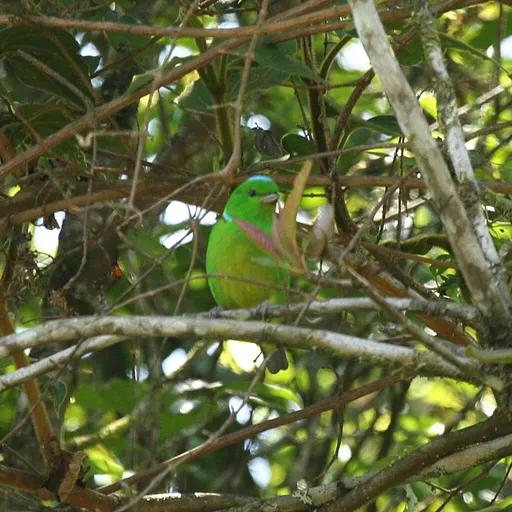
Blue-crowned Chlorophonia
Chlorophonia occipitalis
Least Concern
Overview
The blue-crowned chlorophonia (Chlorophonia occipitalis) is a small bird in the finch family Fringillidae, native to Central America and southern Mexico. It is currently assessed by the IUCN as Least Concern, with an estimated population of at least 50,000 mature individuals, though this number is believed to be decreasing.
Identification
- Plumage: Males are mostly shiny emerald-green with a distinct circular turquoise-blue patch on the crown, a thin blue collar, and a bright yellow lower breast and belly; females have a smaller blue crown patch and green underparts with a yellow center.
- Size: A chunky, short-tailed bird measuring approximately 13 cm (5.1 in) in length and weighing between 25 and 27.5 g.
- Bill: Features a short, stubby bill with a dusky upper mandible having a bluish-grey base and a bluish-grey lower mandible with a dusky tip.
- Song: Emits a liquid tinkling call described as "where'my'shirt" or "two'eet!" alongside a nasal "wrap" and a mournful, low whistle.
Habitat
The species has a disjunct distribution spanning from Veracruz in southeastern Mexico south through Guatemala, El Salvador, Honduras, and into north-central Nicaragua. During the breeding season, it inhabits montane evergreen forests, including cloud forest and pine–oak forest, while outside this period it occupies lower elevation evergreen and secondary forests as well as shady plantations.
Diet
This bird feeds almost exclusively on fruit, with a particular preference for the berries of mistletoe and other small berries, though it may occasionally include insects. Foraging takes place mostly in the forest canopy, typically in pairs during the breeding season or in small flocks of up to twelve individuals at other times.
Did you know?
Both sexes participate in constructing the nest, which is a ball or domed structure made from bark, moss, and plant fibres, and they feed their nestlings via regurgitation. The clutch consists of three white eggs marked with reddish and grey patterns, with incubation lasting approximately 15 days.
Sources
- Wikipedia · CC BY-SA 4.0
- Wikidata · CC0 1.0