
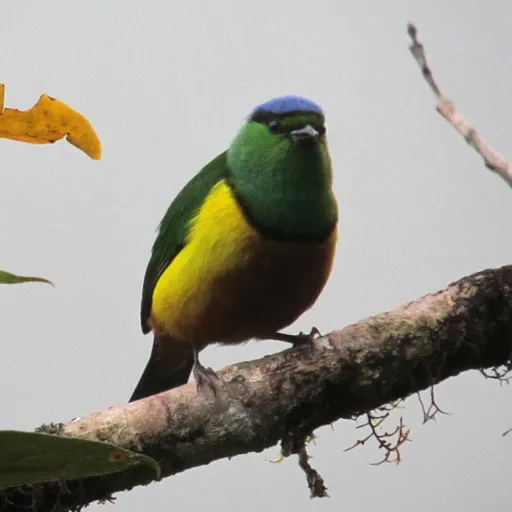
Chestnut-breasted Chlorophonia
Chlorophonia pyrrhophrys
Least Concern
Listen
XC250631 · Niels Krabbe · Zamora-Chinchipe: camp on Ventanilla-Christopher Parson trail, Reserva Tapichalaca, Ecuador · CC BY-SA 4.0
Overview
The chestnut-breasted chlorophonia (Chlorophonia pyrrhophrys) is a species of bird in the family Fringillidae, the finches and euphonias. It is found in the Andes of South America, specifically in Colombia, Ecuador, Peru, and Venezuela. The species is currently assessed as being of Least Concern by the IUCN, although its population is believed to be decreasing.
Identification
- Chunky and short-tailed with a stubby bill, measuring approximately 12 cm in length.
- Adult males feature a rich cyanine-blue crown and nape, shiny emerald-green upper parts, and a deep chestnut center on the lower breast flanked by bright yellow.
- Females are duller and plainer than males, with turquoise-blue crowns and dull yellowish underparts.
- Both sexes possess a blackish bill with a pale gray base to the mandible and dark gray legs.
Habitat
The species inhabits the interior and edges of humid to wet montane forest, including cloudforest heavy with epiphytes, as well as mature secondary and occasionally elfin forest. Its distribution is highly disjunct along the Andes, ranging in elevation from 1,500 to 3,000 m depending on the country.
Diet
The chestnut-breasted chlorophonia feeds mostly on mistletoe berries and lesser amounts of other berries and fruits, occasionally including insects in its diet. It usually forages in pairs or small family groups, predominantly in the forest canopy, especially within clumps of epiphytes, and seldom joins mixed-species flocks or shares fruiting trees with other species.
Did you know?
The bird's song is described as a "mechanical series of squeaks, liquid notes, and whistles, often with a characteristic nasal note inserted," while its common call is a soft, nasal "neck-nuur" or unique series of "bee bee..." notes.
Sources
- Wikipedia · CC BY-SA 4.0
- Wikidata · CC0 1.0