
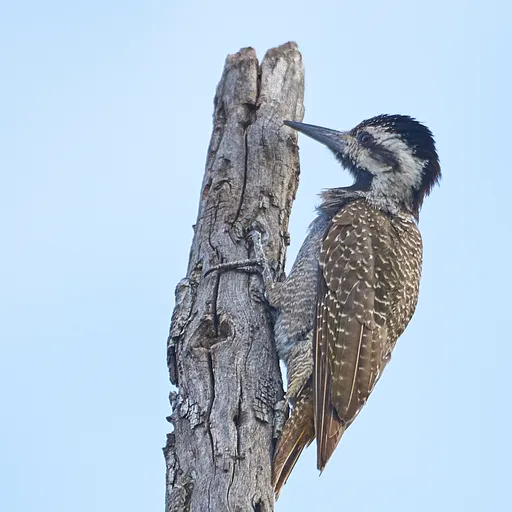
Bearded Woodpecker
Chloropicus namaquus
Overview
The bearded woodpecker (Chloropicus namaquus) is one of the largest woodpeckers in Africa, native to tropical central Africa. It has an extremely wide range and is a fairly common species rated as 'least concern' by the International Union for Conservation of Nature.
Identification
- One of the largest woodpeckers in Africa, growing to a length of about 25 cm.
- Distinctive black and white head featuring a black moustache, a broad black eye-stripe and black crown contrasting with a white supercilium, face, chin and throat.
- Males possess a red hind crown, whereas females lack this feature.
- Upper parts are yellowish-brown with narrow white barring, and the tail is brown barred white with yellowish shafts.
Habitat
Found across Angola, Botswana, Central African Republic, Chad, Democratic Republic of the Congo, Eswatini, Ethiopia, Kenya, Malawi, Mozambique, Namibia, Rwanda, Somalia, South Africa, Sudan, Tanzania, Uganda, Zambia, and Zimbabwe. It inhabits a wide range of habitat types, including woodland with sizeable trees, Brachystegia woodland, Euphorbia and Acacia woodland, the fringes of gallery forests, and brushland. Its distribution spans from lowlands up to altitudes of about 3,000 m.
Diet
The bird forages in pairs, spending long periods on a single tree to hammer, probe and peck, gleaning stray insects, spiders, caterpillars and ants. It occasionally catches geckos and small lizards.
Did you know?
This species often drums loudly on branches, finishing each drum-roll with four taps.