
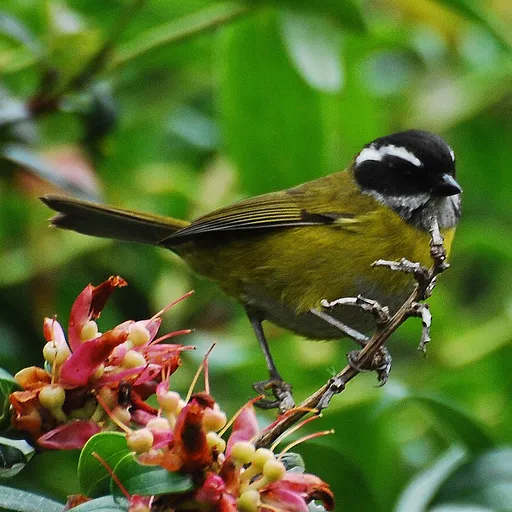
Sooty-capped Chlorospingus
Chlorospingus pileatus
Least Concern
Overview
The sooty-capped chlorospingus, or sooty-capped bush tanager, is a small passerine bird in the family Passerellidae. It is restricted to isolated volcanic ranges in Costa Rica and Panama, where it inhabits montane forests. The species is currently assessed as Least Concern by the IUCN.
Identification
- 13 to 14 cm long with a mostly sooty black head featuring a bold, jagged white stripe from the eye down the neck, often described as resembling a lightning bolt.
- Upperparts and tail are olive, while the most common morph displays a wide band of olive-yellow across the breast and flanks with a yellowish-white belly.
- Possesses a reddish brown iris, a blackish bill, and dull brownish to fuscous black legs.
- Produces a thin, squeaky, twittering song transcribed as 'see-chur see-chur' and calls including high, lisping 'tsit' notes.
Habitat
Found on isolated volcanoes in north-central Costa Rica and the Cordillera de Talamanca extending into northern Panama. It inhabits montane evergreen forest, elfin forest, and mature secondary forest within the subtropical and lower temperate zones, typically ranging between 1,500 and 3,000 m in elevation, though mostly above 2,000 m in Costa Rica.
Diet
Feeds on small arthropods and fruits, foraging in pairs or groups during the breeding season and potentially larger groups of up to 40 individuals outside it. It regularly joins mixed-species feeding flocks and forages in the understory to mid-levels of the forest, seeking food in dense shrubs, on moss branches, in bromeliads, and in clusters of dead leaves.
Did you know?
The bird may be a cooperative breeder, as several adults have been recorded attending a single nest. Its nest is a bulky cup constructed from moss, liverworts, and Usnea lichen, and can be found in unusual locations such as crevices in earthen banks or up to 11 m above the ground in epiphytes.
Sources
- Wikipedia · CC BY-SA 4.0
- Wikidata · CC0 1.0