
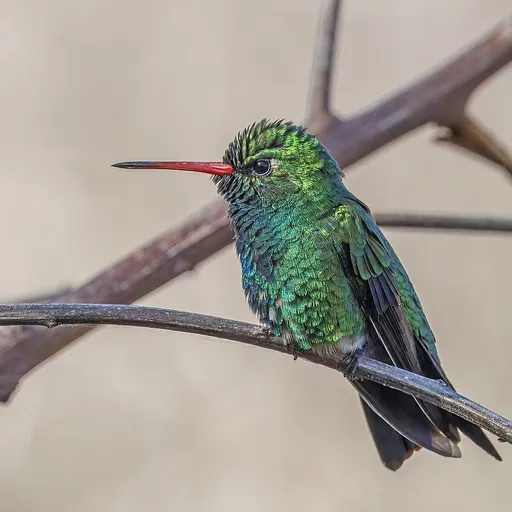
Glittering-bellied Emerald
Chlorostilbon lucidus
Least Concern
Overview
The glittering-bellied emerald (Chlorostilbon lucidus) is a species of hummingbird found across parts of South America. It is a sedentary bird that is generally common throughout its range and currently assessed as Least Concern by the IUCN.
Identification
- Males measure 9.5 to 10.5 cm and females 7.5 to 8.5 cm, with both sexes possessing a short, straight bill.
- Males display a blue-green throat, an iridescent bronze to bronzy green belly, and a dark steely blue tail; the male's bill is red with a black tip, while the female's is black on the outer half and red on the inner.
- The song is described as a high-pitched, cricket-like trill, while the principal call is a short, dry, scratchy rattle.
- Subspecies C. l. igneous is distinguished by glittering orange-gold speckles on its belly.
Habitat
This species inhabits semi-arid to humid, open to semi-open landscapes, including scrublands, savannas, grasslands, forest edges, and human-modified areas such as parks and gardens. Its range extends across Argentina, Bolivia, Brazil, Paraguay, and Uruguay, with occasional vagrancies recorded in Chile and Peru. It is found from sea level to 3,500 m, though it is most common between 500 and 3,500 m.
Diet
The glittering-bellied emerald forages for nectar by trap-lining a circuit of flowering plants, sometimes piercing the bases of flowers to access it. It also captures small insects by hawking from a perch and has been observed consuming insect honeydew. Foraging typically occurs between 4 and 12 m above the ground.
Did you know?
In certain parts of Argentina, this bird is the most frequently seen hummingbird in its region. It constructs its cup nest using fine plant fibers and bark strips bound by spiderweb, then camouflages the exterior with lichen.
Sources
- Wikipedia · CC BY-SA 4.0
- Wikidata · CC0 1.0