
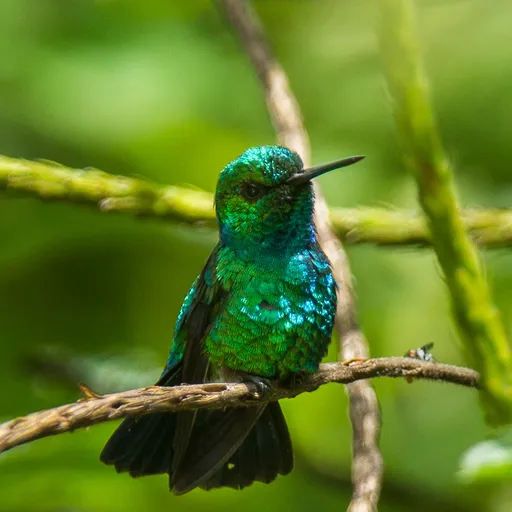
Blue-tailed Emerald
Chlorostilbon mellisugus
Least Concern
Overview
The blue-tailed emerald, Chlorostilbon mellisugus, is a small hummingbird found in tropical and subtropical South America east of the Andes. It ranges from Colombia and the Guianas to northern Bolivia and central Brazil, where it is considered a species of Least Concern.
Identification
- Males are 7.5 to 9.5 cm long and females 6.5 to 7.5 cm, with a short, straight, black bill.
- Males of the nominate subspecies display an iridescent golden green crown, bronze-green upperparts, and a steel blue tail, with glittering emerald underparts that are bluish on the throat.
- Females have bronzy green crowns, a blackish facial mask with a pale gray stripe behind the eye, and pale gray underparts.
- The song consists of repeated 'tsip' or 'chwep' notes, occasionally accompanied by rolls or twitters, while calls include a loud, harsh 'chirrrt' and soft 'tsip', 'pit', or 'chwep' notes.
Habitat
This species inhabits a variety of environments, primarily semi-open to open landscapes such as savannas, cerrado, cultivated areas, and gardens. It also frequents the edges of deciduous woodland, large clearings within terra firme forest, and floodplain forests in Ecuador. Elevation ranges vary by region, from sea level to approximately 2,600 m in Ecuador.
Diet
Foraging behaviour is dominated by trap-lining, where the bird visits a circuit of flowering plants, though in some areas it defends specific patches of flowers. It consumes nectar from a wide variety of low plants, shrubs, and trees at all vegetation levels. Additionally, it hawks for small insects and other arthropods from a perch.
Did you know?
The species' specific epithet derives from Latin words meaning 'to suck honey', a reference that has been attached to the bird since Linnaeus's 1758 description, though it took until 1950 for ornithologist John T. Zimmer to confirm that Linnaeus was describing this particular species.
Sources
- Wikipedia · CC BY-SA 4.0
- Wikidata · CC0 1.0