
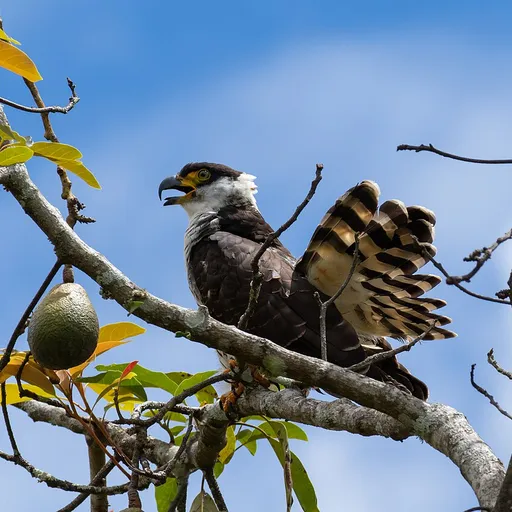
Hook-billed Kite
Chondrohierax uncinatus
Least Concern
Overview
The hook-billed kite (Chondrohierax uncinatus) is a mid-sized, slender raptor in the family Accipitridae that inhabits the Americas. It is classified as Least Concern on the IUCN Red List, though it is closely related to the critically endangered Cuban kite.
Identification
- Mid-sized and slender raptor with a large, downcurved hooked bill that is visible on perched or low-flying individuals.
- Plumage shows extreme variation, with birds appearing blackish or grey (often males) or brown and brick-red (often females).
- Physical dimensions range from 38 to 42 cm in length and 215 to 397 g in weight.
Habitat
This species is distributed across the Americas, including the Rio Grande Valley of Texas in the United States, Mexico, the Caribbean, Central America, and tropical South America.
Diet
Tree snails constitute a vital component of the diet, with the kite holding the prey in a talon to pry open the shell. The bill has adapted in size and shape across different regions to match available tree snail species. Other prey includes terrestrial and aquatic snails, frogs, salamanders, lizards, small mammals, crabs, spiders, caterpillars, and insects.
Did you know?
The physical dimensions of the kite's bill have adapted in different regions of its territory in direct response to the specific species of tree snails available there.
Sources
- Wikipedia · CC BY-SA 4.0
- Wikidata · CC0 1.0