
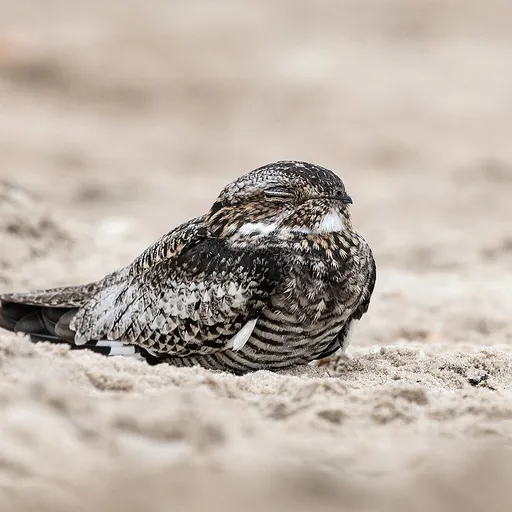
Lesser Nighthawk
Chordeiles acutipennis
Least Concern
Listen
XC909307 · Rosa Elena Albornoz · El Hatillo (near Caracas), Libertador, Capital District, Venezuela · CC0 1.0
Overview
The lesser nighthawk (Chordeiles acutipennis) is a nightjar species found throughout a large part of the Americas. It is a nocturnal insectivore that resembles the common nighthawk but is slightly smaller and more buffy in coloration.
Identification
- Resembles the common nighthawk but is slightly smaller with a less deeply forked tail and buffier coloration.
- Features a large mouth, small feet, and a short, curved beak, with natural brown and gray plumage that camouflages well with its surroundings.
- Males display a prominent white bar at the end of the tail and wing tips, while females have a cream-colored wing bar and lack the tail stripe; both possess a white V-shaped mark on the neck.
- Vocalisations include toadlike trills that can last 7–13 seconds or extend to over 3 minutes, sounding like a low, gurgled laugh.
Habitat
Native to southern North America, this species inhabits arid deserts and grasslands, preferring open, dry habitats at lower elevations compared to the common nighthawk. It breeds in the southern United States and migrates to southern Central America and northern South America for the winter.
Diet
The lesser nighthawk is a predominantly nocturnal insectivore that captures prey in flight, targeting abundant insects such as flies, mosquitoes, moths, and June bugs. It uses its broad mouth, equipped with fine hairs, to trap food and forages either individually or in groups depending on the season.
Did you know?
To survive extreme heat in desert breeding grounds, the bird uses gular fluttering, a process involving quick throat vibrations that pump air into the system to create a cooling effect.
Sources
- Wikipedia · CC BY-SA 4.0
- Wikidata · CC0 1.0