
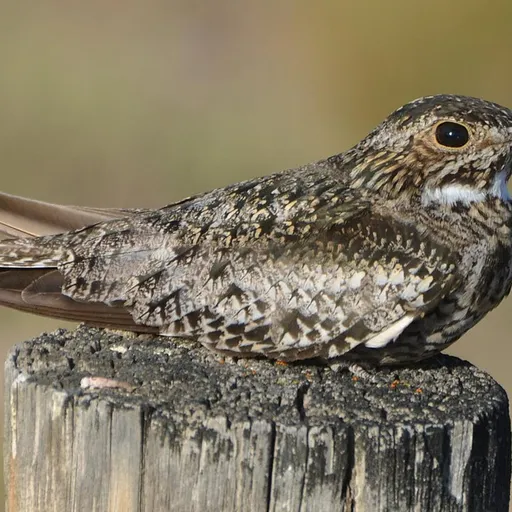
Common Nighthawk
Chordeiles minor
Least Concern
Listen
XC484751 · Oliver Komar · Departamento de La Paz (Near La Florida, Opatoro), Honduras · CC BY-SA 4.0
Overview
The common nighthawk (Chordeiles minor), also known as the bullbat, is a medium-sized crepuscular bird native to the Americas within the nightjar family. Characterised by its cryptic colouration and erratic flight, this species is best identified by its distinctive vocalisations rather than its appearance during the day. It is the only nighthawk found across the majority of northern North America.
Identification
- Typically dark with cryptic grey, black and brown plumage, featuring intricate patterns, noticeable barring on the sides and abdomen, and distinctive white wing-patches.
- Measures 22 to 25 cm in length with a wingspan of 51 to 61 cm; possesses long, slender, pointed wings that extend beyond a notched, forked tail.
- Emits a nasal peent or beernt during flight, while males produce a characteristic boom by flexing their wings during dives.
- Adopts a horizontal stance on the ground or branches due to short legs, and is primarily solitary outside of roosting males.
Habitat
Found in diverse environments including forests, deserts, savannahs, beaches, cities and prairies at elevations from sea level to 3,000 m, this species prefers edge and early successional habitats. It is drawn to urban built-up areas by insect availability and often perches on flat gravel rooftops. The bird breeds across northern North America and winters in southern South America.
Diet
As an aerial insectivore, the common nighthawk hunts on the wing for extended periods at high altitudes or in open areas, primarily targeting crepuscular flying insects. It shows a preference for beetles and Hymenoptera such as bees, ants and wasps, while actively avoiding flies. Foraging typically occurs at dusk and dawn, though night-time feeding in complete darkness is rare.
Did you know?
The common nighthawk is credited with inspiring the nickname "Bugeater State" for Nebraska, as its insect-eating habits led to the association with eating bugs.
Sources
- Wikipedia · CC BY-SA 4.0
- Wikidata · CC0 1.0