
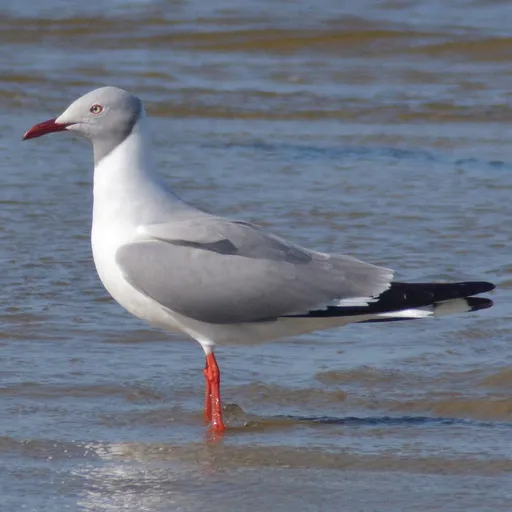
Grey-headed Gull
Chroicocephalus cirrocephalus
Listen
XC1149004 · Kileo Jumah · Ngorongoro Conservation Area (crater floor), Arusha, Tanzania · CC0 1.0
Overview
The grey-headed gull (Chroicocephalus cirrocephalus), also known as the grey-hooded gull, is a small gull species that breeds patchily in South America and sub-Saharan Africa. While not truly migratory, it is dispersive and becomes more widespread in winter, with rare vagrant records from the United States, Italy, and Spain.
Identification
- Summer adults have a pale grey head, grey body, and red bill and legs; the hood is lost in winter, leaving only dark smudges around the eyes.
- Slightly larger than a black-headed gull at 42 cm, with broader wings and conspicuous white 'mirrors' on the black primary wingtips.
- Dark underwings with black wingtips; adults have white irises, while immatures have dark eyes and a black terminal tail band.
- Noisy, with a raucous, crow-like 'caw, caw' call.
Habitat
Locally abundant and breeding in large colonies within reedbeds and marshes, though the species is predominantly coastal or estuarine. It is rarely seen at sea far from land and is highly gregarious in winter, forming flocks of hundreds or thousands in roosts and feeding areas.
Did you know?
Recent genetic evidence suggests that the South American and African populations may be two separate cryptic species, as the African subspecies appears more closely related to the also-African Hartlaub's gull than to the nominate South American form.