
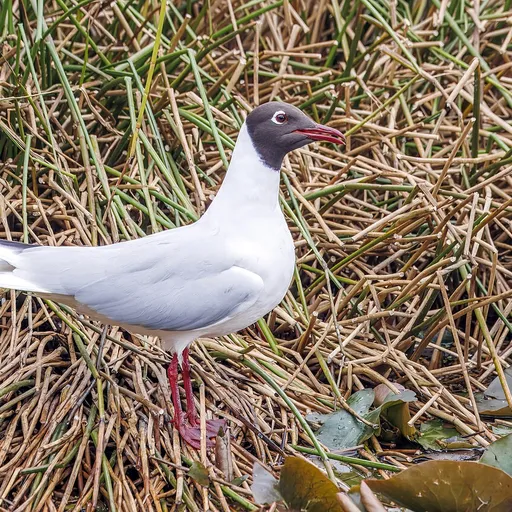
Brown-hooded Gull
Chroicocephalus maculipennis
Overview
The brown-hooded gull, Chroicocephalus maculipennis, is a species of gull native to South America and the South Atlantic. It is found in Argentina, southeastern Brazil, Chile, Uruguay, and the Falkland Islands. The specific epithet 'maculipennis' translates to 'spotted wings', referring to the black tips on its outer flight feathers.
Identification
- Adults in breeding plumage possess a dark brown head and throat with a distinct white semicircle around the back of the eye, contrasting with a white neck, chest, and abdomen.
- In non-breeding plumage, the brown hood is largely absent, leaving only a dark spot behind the eye and a smudge around the eye.
- The bill and legs are red, and the eye is dark brown; outer primary flight feathers are white with black tips above and show extensive black from below.
- Young birds have mottled pale brown wings, a black bar on the tail tip, paler orange-red legs, and an orange-red bill with a dark tip.
Habitat
This species breeds in Argentine and Chilean Patagonia, the Falkland Islands, and Uruguay, while its winter range extends to the coasts of northern Chile and central Brazil. It inhabits freshwater lakes, intertidal marshes, river banks, and open fields, with the highest concentrations in central Chile and eastern Argentina.
Diet
Their diet consists primarily of insects, carrion, and food acquired through kleptoparasitism. They specifically steal crabs from red-gartered coots and clams from American oystercatchers, finding the theft from coots to be 3.5 times more profitable than from oystercatchers.
Did you know?
The brown-hooded gull is a kleptoparasite that actively steals food from other species, targeting red-gartered coots for crabs and American oystercatchers for clams. They construct floating nests within aquatic vegetation at the edges of ponds and lakes.