
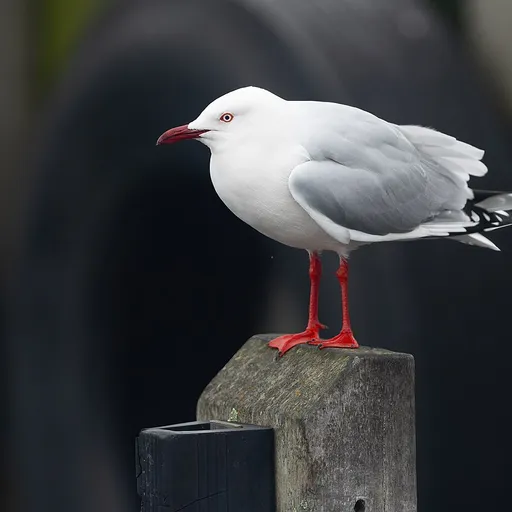
Silver Gull
Chroicocephalus novaehollandiae
Least Concern
Overview
The silver gull (Chroicocephalus novaehollandiae) is a gull species found throughout Oceania and is the most common gull in Australia. It is smaller than the Pacific gull, which shares its range, and is classified as a species of Least Concern by the IUCN.
Identification
- Adults possess white heads, bodies, and tails, with light grey wings featuring white-spotted, black tips.
- Birds measure between 40–45 cm in length and have bright red beaks that intensify in colour during breeding or with age.
- Juveniles are distinguished by brown patterns on their wings and dark beaks.
- The vocalisation is sharp and varied, most commonly a harsh, high-pitched 'kwarwh'.
Habitat
This species inhabits all states of Australia, as well as New Zealand and New Caledonia, with a strong preference for coastal areas. It is highly adaptable to human environments, thriving around beaches, urban centres, and rubbish tips, where its population is limited only by the availability of nesting grounds.
Diet
Naturally, the silver gull feeds on worms, fish, insects, and crustaceans. It is also an effective scavenger that often pesters humans for food items such as chips and steals unattended meals.
Did you know?
This bird has twice been recorded in the United States, appearing at the mouth of the Genesee River in 1947 and in Salem County, New Jersey, in 1996, though both instances are believed to involve birds that escaped from captivity.
Sources
- Wikipedia · CC BY-SA 4.0
- Wikidata · CC0 1.0