
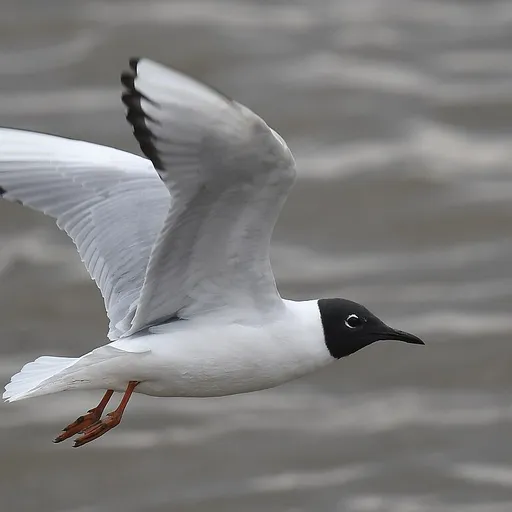
Bonaparte's Gull
Chroicocephalus philadelphia
Listen
XC926085 · steve · Petersburg, Petersburg Borough, Alaska, United States · CC BY-SA 4.0
Overview
Bonaparte's gull (Chroicocephalus philadelphia) is a small gull species found mainly in northern North America. At 28 to 38 cm in length, it is one of the smallest gull species, ranking only behind the little gull and Saunders's gull.
Identification
- Small, slender body with grey upperparts and white underparts; grey plumage extends up the rear of the neck to just below the head.
- Adults in breeding season display a distinct slaty-black hood, which is absent in non-breeding plumage.
- Short, thin, black bill and pinkish-red (winter) to orangish-red (summer) legs.
- Graceful, tern-like flight with conspicuously white underwings.
Habitat
Breeds in open areas of boreal forest across southern Alaska, interior western Canada, and as far east as central Quebec, typically nesting in conifers near open water. Winters along the coasts of North America and in the Great Lakes. It is a rare but annual vagrant to western Europe and the Azores.
Diet
Diet varies seasonally, being largely insectivorous during the breeding season with a shift to fish, crustaceans, mollusks, and invertebrates in winter. They are known to congregate in large numbers to feed on termite swarms and salmon eggs. Bonaparte's gulls also engage in kleptoparasitism, stealing earthworms from foraging dunlins and black-bellied plovers.
Did you know?
Unlike most other gull species that nest on the ground, Bonaparte's gulls typically build their nests in trees, almost exclusively in conifers such as black spruce, northern whitecedar, and jack pine.