
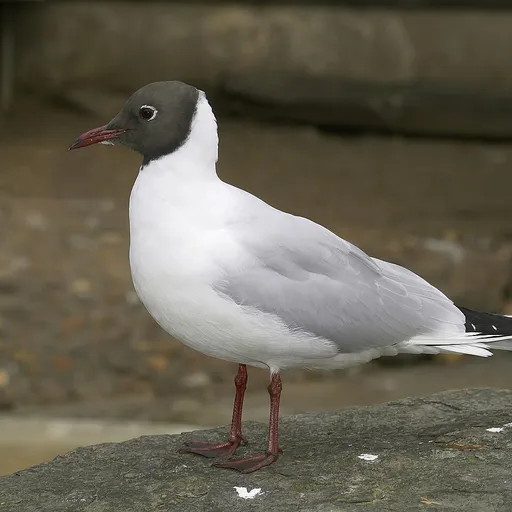
Black-headed Gull
Chroicocephalus ridibundus
Least Concern
Listen
XC707070 · Sonothèque ADVL · Genêts, Manche, Normandie, France · CC0 1.0
Overview
The black-headed gull (Chroicocephalus ridibundus) is a small gull that breeds across much of the Palearctic in Europe and Asia, with smaller populations in eastern Canada. It is a migratory species that winters further south, though many individuals remain in the milder climates of northwestern Europe.
Identification
- Measures 34–39 cm in length with a wingspan of 100–110 cm and weighs between 166 and 400 g. - Summer adults feature a chocolate-brown head (appearing black from a distance), white underparts, pale grey wings, and a red bill and legs. - In flight, a white leading edge on the outer wings contrasts with the dark underside of the inner primaries. - Winter plumage lacks the full hood, leaving only two dark spots above and behind the eye.
Habitat
Breeding colonies are established in large reed beds, marshes, or on lake islands, with populations ranging from single pairs to over 10,000 pairs. The species is highly gregarious in winter, often gathering in large evening roosts and feeding flocks, but it is rarely seen at sea far from coasts.
Diet
As a bold and opportunistic feeder, it consumes insects, fish, seeds, worms, and carrion. It forages with equal facility in ploughed fields, towns, and marshlands, often feeding by walking through water or waiting on flat surfaces.
Did you know?
The black-headed gull is the official bird of Tokyo, and the Yurikamome automated guideway transit in Tokyo Bay is named after it. In Richard Adams' novel Watership Down, a character named Kehaar is characterised as a gull who claims his name is the onomatopoeia of waves breaking against the shore.
Sources
- Wikipedia · CC BY-SA 4.0
- Wikidata · CC0 1.0