
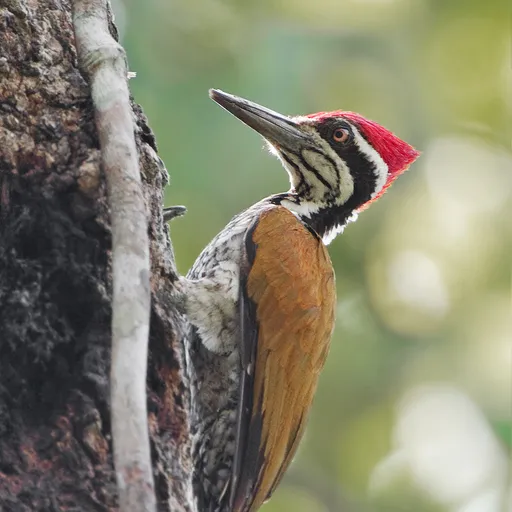
Greater Flameback
Chrysocolaptes guttacristatus
Least Concern
Listen
XC983352 · Dinesh Chaudhary · Karanjawa Nature Trail (near Diwan Tembrun), Gujarat, India · CC BY-SA 4.0
Overview
The greater flameback, also known as the greater goldenback or large golden-backed woodpecker, is a large woodpecker species found across South and Southeast Asia. It is classified as Least Concern on the IUCN Red List and is widely distributed, from the northern Indian subcontinent to parts of the Malay Peninsula and Borneo.
Identification
- A large woodpecker measuring approximately 33 cm in length with a typical erect body shape, a long neck, and a distinctive erect crest.
- Features a straight, pointed bill that is longer than the head, lead-grey legs with four-toed zygodactyl feet, and whitish to yellow irises.
- Plumage varies by subspecies but consistently displays an unmarked golden-yellow to dark brown back and wings, a red rump, and a black tail; the head is often whitish with black patterns or coloured yellow, brown, or red.
- Adult males always possess a red crown, while females have crowns that vary in colour depending on the subspecies, such as black spotted with white, yellow, or brown with lighter dots.
Habitat
This species occurs widely across the northern Indian subcontinent, extending eastwards to southern China, the Malay Peninsula, Sumatra, western and central Java, and northeast Borneo. It is associated with a diversity of rather open forest habitats, including the foothills of the Himalayas, the Western Ghats, and mangrove forests.
Diet
The greater flameback forages by digging out food from trees using its bill, supported by its zygodactyl feet and stiff tail. It uses its long tongue to extract wood-boring arthropod prey and mainly feeds on small invertebrates, although it also drinks nectar.
Did you know?
In Malaysian mangrove forests, the greater flameback shows a specific preference for foraging in tall Avicennia alba trees, unlike the similar common flameback, which uses that species as well as Bruguiera parviflora and Sonneratia alba indiscriminately.
Sources
- Wikipedia · CC BY-SA 4.0
- Wikidata · CC0 1.0