
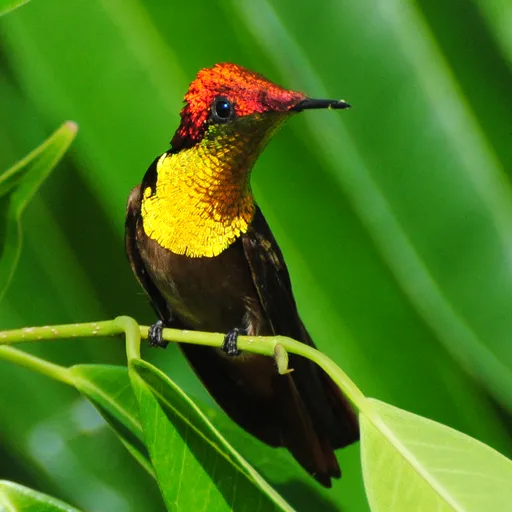
Ruby-topaz Hummingbird
Chrysolampis mosquitus
Least Concern
Overview
The ruby-topaz hummingbird (Chrysolampis mosquitus) is a small neotropical bird in the subfamily Polytminae, commonly known as the mangoes. It is the sole member of the genus Chrysolampis and is assessed as Least Concern by the IUCN.
Identification
- Males possess dark brown upperparts with an olive gloss, a glossy ruby red crown and nape, and iridescent golden or emerald green throats.
- Females feature bronze-green upperparts, pale grey underparts, and a chestnut tail with a dark subterminal band and white tip.
- Adults measure 8 to 9.5 cm in length and have an almost straight, black bill that is relatively short compared to other hummingbirds.
- The song is described as a doubled 'tliii...tliii...tliii', typically delivered from a high perch.
Habitat
Found from eastern Panama through northern South America to northeastern Brazil, extending into eastern Bolivia and the ABC Islands and Trinidad and Tobago. It inhabits open savanna-like landscapes, shrubby arid hillsides, gardens, and cultivated areas, primarily below 500 m but occasionally up to 1,700 m.
Diet
Feeds on nectar from flowering shrubs, trees, epiphytes, cacti, and crops, with a preference for the samaan tree and Ixora plant due to their high sugar content. Males defend feeding territories, and the species also catches small insects and spiders on the wing or gleans them from within foliage.
Did you know?
The genus name Chrysolampis derives from the Ancient Greek khrusolampis, meaning 'glow-worm', while the specific name mosquitus is a Spanish diminutive for 'little fly'.
Sources
- Wikipedia · CC BY-SA 4.0
- Wikidata · CC0 1.0