
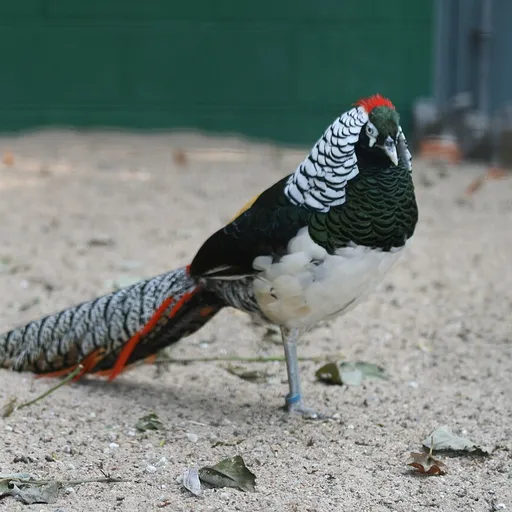
Lady Amherst's Pheasant
Chrysolophus amherstiae
Least Concern
Overview
Lady Amherst's pheasant (Chrysolophus amherstiae), also known as the Chinese copper pheasant, is a bird of the family Phasianidae native to southwestern China and far northern Myanmar. The species, which is evaluated as Least Concern on the IUCN Red List, has a long history of introduction in England, though wild populations there are now considered locally extinct despite occasional sightings of escapees.
Identification
- The adult male is 100–120 cm long, featuring a white and black nuchal cape, a red crest, and a long greyish-white tail with black bars and red streaks.
- The male displays a white chest and belly, a scaled green throat, a dark green back, blue and brown wings, and a yellow rump, with a horn-coloured bill and blue-grey legs.
- The female is less showy with duller mottled brown plumage and finer barring than the female common pheasant, possessing a darker head and cleaner underparts than the female golden pheasant.
- Males emit a metallic call during the breeding season and can produce a distinctive wing sound when bursting upwards.
Habitat
This species inhabits dense, dark forests with thick undergrowth in its native range of southwestern China and far northern Myanmar. Historically, it established feral populations in England, particularly in West Bedfordshire, but has declined due to predation, habitat loss, and destruction of woodland understorey.
Diet
These birds forage on the ground, feeding on a diet of grain, leaves, and invertebrates. Although they can fly, they prefer to run and roost in trees at night.
Did you know?
The English name and the specific epithet amherstiae commemorate Sarah Amherst, who sent the first specimen of the bird to London in 1828.
Sources
- Wikipedia · CC BY-SA 4.0
- Wikidata · CC0 1.0