
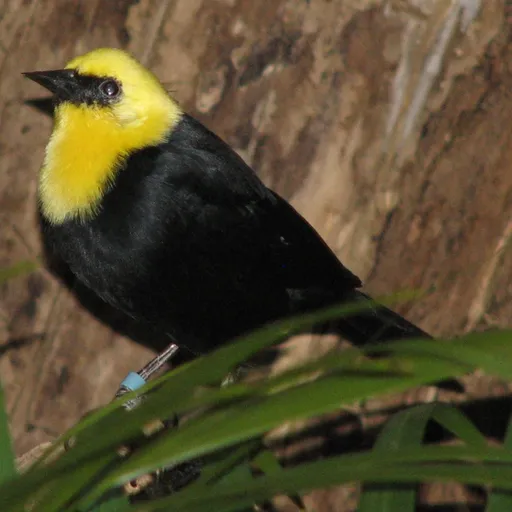
Yellow-hooded Blackbird
Chrysomus icterocephalus
Least Concern
Overview
The yellow-hooded blackbird (Chrysomus icterocephalus) is a species of New World blackbird belonging to the family Icteridae. It is assessed as Least Concern by the IUCN, with a very large range and an increasing population estimated at over 500,000 mature individuals.
Identification
- Size approx 17–19 cm; adult males weigh average 35.9 g, females 26.8 g.
- Sexually dimorphic: male nominate subspecies has bright yellow head, throat, neck and upper breast with black lores, and glossy black plumage elsewhere.
- Female nominate has yellow supercilium, throat and upper breast, citrine crown and face, dull grayish-olive upperparts with dusky streaks, and olive-streaked brownish belly.
- Bill black in males, often with pale base in females; both sexes have dark brown irises and black legs and feet.
Habitat
Found in eastern Panama, Colombia, Venezuela, Trinidad, the Guianas, and parts of Brazil and Peru, with vagrancies recorded in Caribbean islands. Primarily inhabits marshes, várzea grasslands, savanna, mangroves, and agricultural lands, especially rice fields. Elevation ranges up to about 400–600 m for the nominate subspecies, with C. i. bogotensis found at around 2,600 m on the Bogotá plateau.
Diet
Feeds on seeds and insects, with cultivated rice being an important part of its diet. Forages mostly in grass and low vegetation, occasionally on the ground. In the breeding season it forms small groups, but flocks of up to 600 have been noted in the non-breeding season.
Did you know?
The species is polygynous, with males building several cup-shaped nests from wet sedge and grass, which females then choose and line with fine plant fibers; in some areas, the shiny cowbird parasitises a third or more of the nests.
Sources
- Wikipedia · CC BY-SA 4.0
- Wikidata · CC0 1.0