
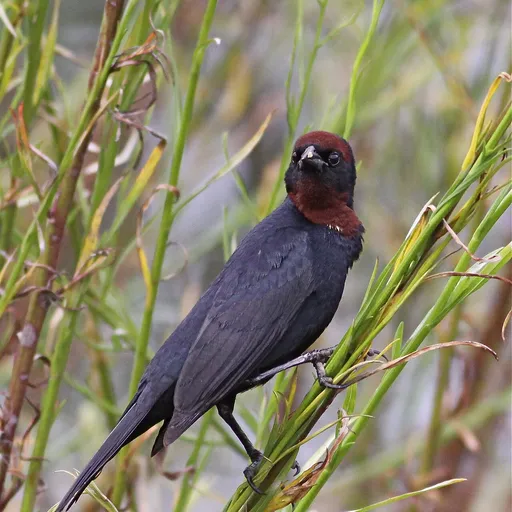
Chestnut-capped Blackbird
Chrysomus ruficapillus
Least Concern
Overview
The chestnut-capped blackbird (Chrysomus ruficapillus) is a species of New World blackbird found in southern South America. It is classified as a species of Least Concern by the IUCN due to its very large range and stable population.
Identification
- Males are primarily black with a faint bluish gloss, while females are olivaceous brown with faint dark streaks on the underparts.
- Both sexes possess a black bill and black legs and feet, distinguishing them from some other regional species.
- Males sing two highly variable song types: one beginning with clicks or whistles and ending in a descending nasal buzz, and another consisting of loud, tremulous whistles or flute-like ascending notes.
- A soft 'zeb' is the species' primary contact call.
Habitat
This bird inhabits a variety of wet landscapes including marshes, rice fields, wet grasslands, and croplands, occasionally roosting in nearby open woodlands. Its range covers parts of Argentina, Bolivia, Brazil, Paraguay, and Uruguay, with the northern subspecies favouring irrigated fields and barnyards in eastern Brazil and the nominate subspecies extending across southern Brazil, Uruguay, and into western Paraguay and eastern Bolivia.
Diet
The species feeds primarily on seeds, including grass seeds and rice, alongside significant amounts of insects and spiders. It forages in large flocks of one thousand or more individuals, sometimes joining other icterid species, and eats in emergent vegetation or on dry ground within marshes.
Did you know?
The chestnut-capped blackbird is considered a major agricultural pest in rice-growing areas, yet attempts at control have generally been unsuccessful. It can form enormous flocks of 'several thousands' of birds, and males may build multiple nests, with up to 350 nests found in a single rice field colony.
Sources
- Wikipedia · CC BY-SA 4.0
- Wikidata · CC0 1.0