
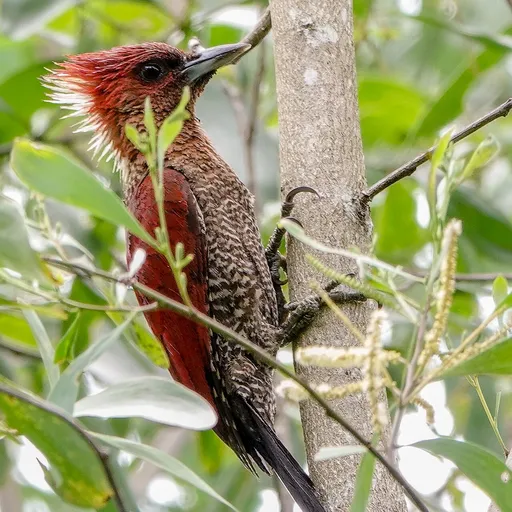
Banded Woodpecker
Chrysophlegma miniaceum
Least Concern
Overview
The banded woodpecker (Chrysophlegma miniaceum), also known as the banded red woodpecker, is a species of bird in the family Picidae. It is a sedentary, non-migratory species native to tropical southeastern Asia, where it has successfully adapted to inhabit man-made environments such as parks and wooded suburbs.
Identification
- Measures approximately 26 cm in length with predominantly rufous-brown upper parts, a dull olive-scaled mantle, and a yellow rump.
- The head is mostly rufous-brown with a shaggy yellowish nape; males possess a redder face and throat, while females have browner faces and throats flecked with white.
- Features a dark beak, a chestnut eye surrounded by a bluish orbital ring, and greenish legs.
- Underparts include a reddish-barred breast and a whitish belly heavily barred with brownish-black.
Habitat
Found across Brunei, Indonesia, Malaysia, Myanmar, Singapore, and Thailand, the species mainly inhabits subtropical or tropical moist lowland forests. It is also recorded in mangrove forests, secondary forests, plantations, and overgrown gardens.
Diet
Feeding singly or in pairs, the bird forages unobtrusively among vines, dense cover, and the canopy, probing into crevices, moss, and epiphytes. Its diet primarily consists of ants, their eggs and larvae, along with other small invertebrates.
Did you know?
Although its main habitat is primary rainforest, the species has adapted so well to man-made environments that it now thrives in parks, wooded suburbs, and overgrown gardens. Breeding schedules vary significantly by location, with nesting activities observed in January in the Malay Peninsula and nestlings present from February through August.
Sources
- Wikipedia · CC BY-SA 4.0
- Wikidata · CC0 1.0