
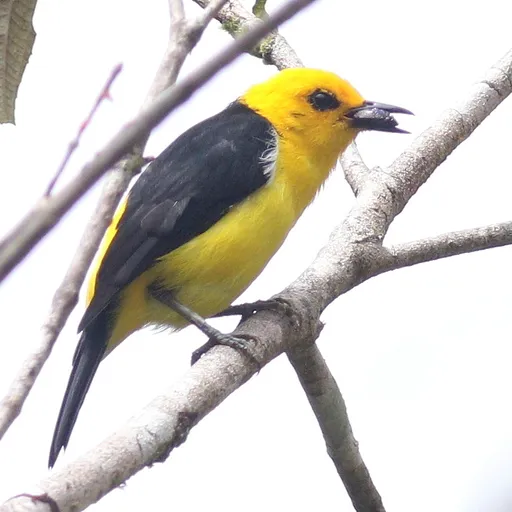
Black-and-yellow Tanager
Chrysothlypis chrysomelas
Least Concern
Overview
The black-and-yellow tanager, Chrysothlypis chrysomelas, is a small bird in the family Thraupidae found in the Caribbean and Pacific regions of Central America. It is currently assessed by the IUCN as being of Least Concern, though its population is believed to be decreasing.
Identification
- Males are predominantly bright yellow with a jet-black hindneck, mantle, wings, and tail, distinguished by a thin black ring around the eye.
- Females exhibit a greenish olive head and upperparts, with yellow throats, breasts, and flanks, along with dusky flight feathers edged in greenish olive.
- The bird measures 12 to 13 cm in length and possesses a thin, sharply pointed bill with a blackish structure, resembling a New World warbler.
- Its vocalisation includes a sharp, sibilant 'tsee' or 'tseeeut' often heard in flight, mimicking the sound of a hummingbird.
Habitat
This species inhabits the canopy and edges of primary and mature secondary evergreen forests in the upper tropical and lower subtropical zones, occasionally appearing in forest clearings with tall trees. Its range spans the Caribbean slopes of Costa Rica and parts of Panama, extending to the Pacific slope of Panama and into northwestern Colombia.
Diet
The black-and-yellow tanager feeds on arthropods and fruit, with Miconia berries forming an important part of its diet. Foraging is typically done in pairs or groups of up to six individuals, often joining mixed-species feeding flocks. It captures prey by gleaning from leaves and branches, probing dead leaves, hovering, or taking food in mid-air with short flutter-flights.
Did you know?
The only known nest of this species was a cup constructed from thin rootlets and lined with fungal rhizomorphs, featuring a layer of dead leaves and green moss on the exterior. It was situated near the end of a tree branch approximately 8 metres above the ground.
Sources
- Wikipedia · CC BY-SA 4.0
- Wikidata · CC0 1.0