
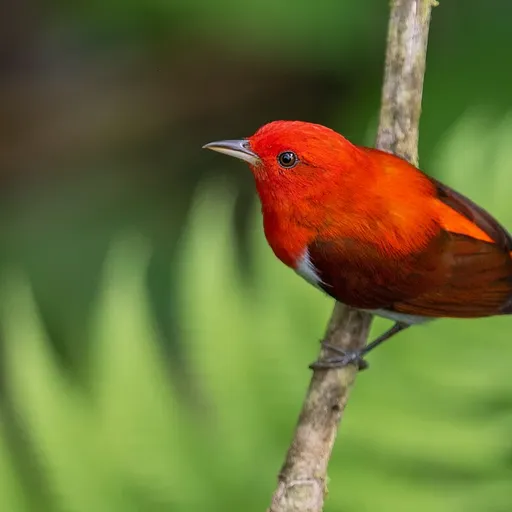
Scarlet-and-white Tanager
Chrysothlypis salmoni
Least Concern
Listen
XC242401 · Niels Krabbe · Esmeraldas: 18.5 road km NNW Alto Tambo, Ecuador · CC BY-SA 4.0
Overview
The scarlet-and-white tanager (Chrysothlypis salmoni) is a small bird in the family Thraupidae, found in Colombia and northern Ecuador. It inhabits subtropical or tropical moist lowland forests, as well as heavily degraded former forests and secondary growth. The species is classified as Least Concern by the IUCN due to its large range and relative commonness.
Identification
- Males feature bright scarlet upperparts, darker red wings with brownish-black flight feathers, and white underparts marked by a scarlet median stripe down the throat and belly.
- Females resemble males but possess olive-brown upperparts instead of scarlet, with yellowish-buff tinges on the throat and chest.
- The species is approximately 12 cm long, with a dusky upper mandible, pale yellow lower mandible, and grayish-horn legs.
- The song is an inconspicuous, high-pitched sequence, and the flight call is a weak chip or sciip.
Habitat
Found on the Pacific slope of the western and central Andes in Colombia and Ecuador, typically between elevations of 25–1,200 m, but occasionally up to 1,700 m in the Chocó of the Cordillera Central. It prefers stunted secondary growth on foothills, especially near dense, mossy woodland around ridge tops, steep canyon slopes, or landslide scars, as well as openings in tall, wet forests. The bird is non-migratory and shows no recorded local movements.
Diet
The tanager feeds mainly on fruit and arthropods, with fruit constituting about 58% of its diet, often from arillate species such as Tovomitopsis, Clusia, and Miconia. Foraging is conducted singly, in pairs, or in small groups of up to six, and frequently in mixed-species flocks with other tanagers, particularly those of the genus Tangara. It catches insects via gleaning, hovering, or aerial sallies, usually at elevations of 4.5–15 m.
Did you know?
Previous young of the species may assist at the nest, a cooperative breeding behaviour not commonly seen in many bird families.
Sources
- Wikipedia · CC BY-SA 4.0
- Wikidata · CC0 1.0