
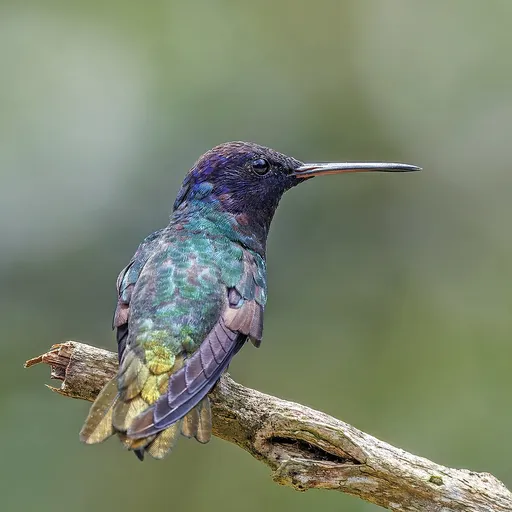
Golden-tailed Sapphire
Chrysuronia oenone
Least Concern
Listen
XC249358 · Niels Krabbe · Napo: 3 km NW Guagua Sumaco, Ecuador · CC BY-SA 4.0
Overview
The golden-tailed sapphire, Chrysuronia oenone, is a species of hummingbird found across parts of South America. It was formerly classified in the genus Amazilia but was moved to Chrysuronia to ensure monophyly following a 2014 molecular phylogenetic study.
Identification
- Size: Small, measuring 9.5 to 10 cm (3.7 to 3.9 in) in length, with males weighing 4.7 to 6.3 g and females 4.3 to 5.3 g.
- Plumage: Adult males of the nominate subspecies possess a violet-blue head and throat, a bright green back, and copper-bronze coverts and tail; females feature a blue crown, green back, and copper-bronze coverts with whitish undersides marked with blue-green and green flecks.
- Bill: Both sexes have a slightly curved bill with a black maxilla and a red mandible with a black tip.
- Song: The song is a repeated rhythmic phrase starting with a burry note, followed by squeaky or scratchy notes and ending with repeated chips, accompanied by drawn-out metallic trills and chipping calls.
Habitat
This species inhabits semi-open landscapes such as forest edges, gaps in humid forest, mature secondary forest, gallery forest, cacao and coffee plantations, and gardens. Its range covers parts of Bolivia, Brazil, Colombia, Ecuador, Peru, and Venezuela, spanning elevations from sea level up to 1,500 m in Colombia and Venezuela.
Diet
The golden-tailed sapphire forages for nectar from flowering shrubs and trees, with males often foraging in the canopy and females trap-lining through the forest. It also consumes arthropods by hawking from perches or gleaning from foliage.
Did you know?
Males frequently gather in 'quarrelsome assemblages' of five to ten individuals at leks to display to females, although they may sometimes display alone.
Sources
- Wikipedia · CC BY-SA 4.0
- Wikidata · CC0 1.0