
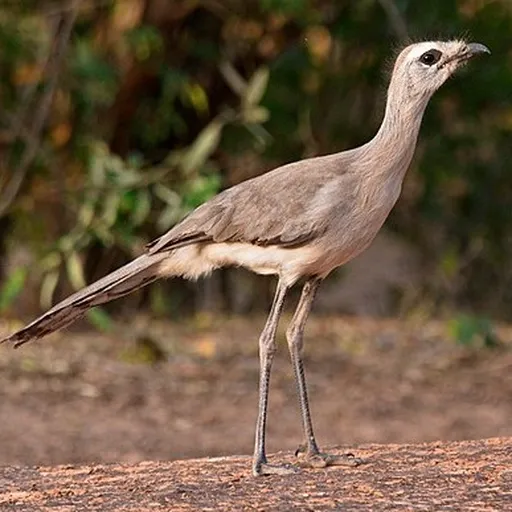
Black-legged Seriema
Chunga burmeisteri
Least Concern
Overview
The black-legged seriema (Chunga burmeisteri) is a large, ground-dwelling bird that belongs to the family Cariamidae. It is one of only two living species of seriemas and is found across parts of South America, including southeastern Bolivia, northern Paraguay, and north-central Argentina.
Identification
- A large, ash-grey bird measuring 70–85 cm in length, with a long neck, long tail, and very long, slender black legs.
- Features a stout, black bill with a strongly decurved culmen and reddish-brown irises.
- The body is finely vermiculated with black and white, with whitish supercilia and lores, and a yellowish-white lower abdomen and thighs.
- Produces loud, slow, and evenly pitched duets that sound like kookaburras, turkeys, or yelping dogs.
Habitat
This dry-country bird inhabits savanna, shrubland, and dry, open forest environments, including the Dry Chaco and the Monte Desert. It is generally found at elevations below 800 m, lower than its red-legged counterpart, and will forage in untreed areas only when wooded regions are nearby.
Diet
As an omnivore, the black-legged seriema eats insects, particularly beetles and locusts, along with occasional rodents, leaves, grass, and seeds. It often hunts around the feet of livestock, which help flush out insects as they move.
Did you know?
The Toba people of Argentina traditionally make a poultice from the bird's manure to treat boils and abscesses. Additionally, the species was not known from Bolivia until the late 1970s, despite being present there.
Sources
- Wikipedia · CC BY-SA 4.0
- Wikidata · CC0 1.0