
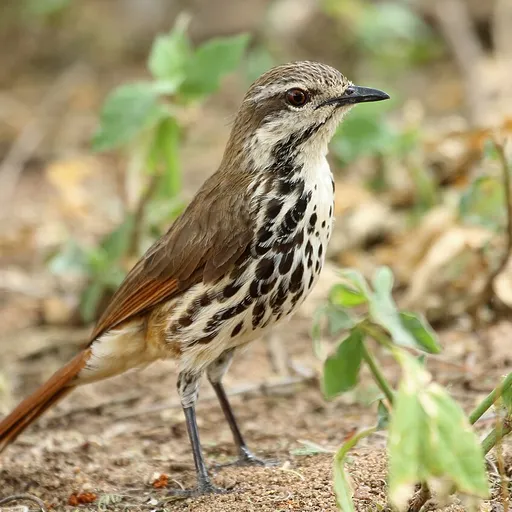
Spotted Palm Thrush
Cichladusa guttata
Least Concern
Overview
The spotted palm thrush, also known as the spotted morning-thrush, is a small bird in the Muscicapidae family. It is classified as Least Concern on the IUCN Red List.
Identification
- Length of 16-17 cm with a body mass of 17-30 grams
- Warm brown plumage from crown to wings, featuring a dark brown eye stripe
- Black-arrowed, creamy white underparts
- Males and females are monomorphic, showing little variance in appearance
Habitat
Found in eastern African countries including Ethiopia, Kenya, Somalia, Sudan, Tanzania, and Uganda, as well as the easternmost DRC and southernmost Sudan. It inhabits subtropical or tropical dry forests, dry savannas, and moist shrublands, often dwelling in dense undergrowth within savannas, woodlands, dry watercourses, thickets, and scrub habitats.
Diet
This forager consumes invertebrates such as small snails, as well as cordia fruits. Juveniles primarily feed on bush-cricket nymphs, beetle larvae, lampyrinae larvae, and moth caterpillars. Foraging occurs on the ground, either singly or in pairs, including in human-populated areas near game-park lodges and gardens.
Did you know?
Spotted palm thrushes engage in vocal duets where females sing during the silent intervals between male notes. To indicate excitement, they raise their bodies, pointing their heads and bills upward to display their spotted throats.
Sources
- Wikipedia · CC BY-SA 4.0
- Wikidata · CC0 1.0