
White Stork
Ciconia ciconia
Least Concern
Listen
XC922887 · Sonothèque ADVL · Vains, Manche, Normandie, France · CC0 1.0
Overview
The white stork (Ciconia ciconia) is a large bird in the stork family, Ciconiidae, characterised by its striking black and white plumage. It is a long-distance migrant that breeds across parts of Europe, Africa and Asia, and winters in Sub-Saharan Africa or the Indian subcontinent. Rated as least concern by the IUCN, the species has successfully resumed breeding in several European countries following conservation and reintroduction programmes.
Identification
- Large bird with a length of 100–115 cm and a wingspan of 155–215 cm.
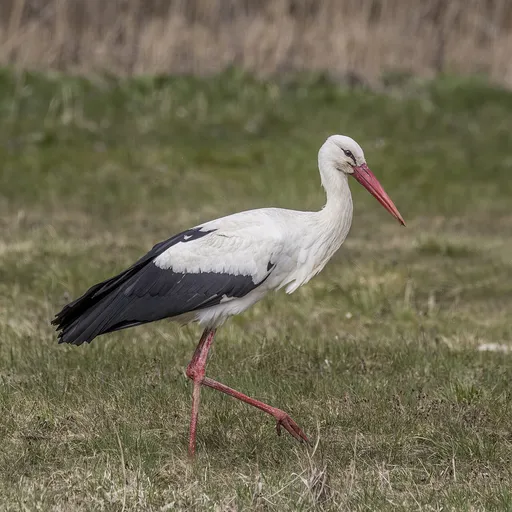
- Plumage is mainly white with black flight feathers and wing coverts, featuring a shaggy ruff on the breast.
- Adults possess long, bright red legs and a long, straight, pointed red beak, while juveniles have duller brownish-red bills and black-tipped feathers.
- When resting, the bird often hunches its head between its shoulders, contrasting with its neck being fully stretched forward in flight or when walking.
Habitat
Breeding populations favour open grasslands, farmland and shallow wetlands, specifically avoiding areas overgrown with tall grass or shrubs. The species breeds across a wide range in Europe, northwestern Africa and western Asia, while its wintering grounds extend across Sub-Saharan Africa and parts of India. Its preferred feeding grounds consist of grassy meadows and shallow water, although some populations have been forced to forage in rubbish dumps in parts of Poland, the Middle East and South Africa.
Diet
As a carnivore, the white stork eats a wide range of animal prey, including insects, fish, amphibians, reptils, small mammals and small birds. It forages primarily by taking food from the ground among low vegetation or from shallow water. In some regions, such as Poland, poor natural foraging grounds have led to the bird seeking food in rubbish dumps.
Did you know?
The vivid red colouration of an adult's beak and legs is derived from carotenoids in its diet, with studies in parts of Spain showing the pigment is specifically based on astaxanthin obtained from an introduced species of crayfish. This species has also given rise to many legends across its range, of which the best-known is the story of babies being brought by storks.
Sources
- Wikipedia · CC BY-SA 4.0
- Wikidata · CC0 1.0