
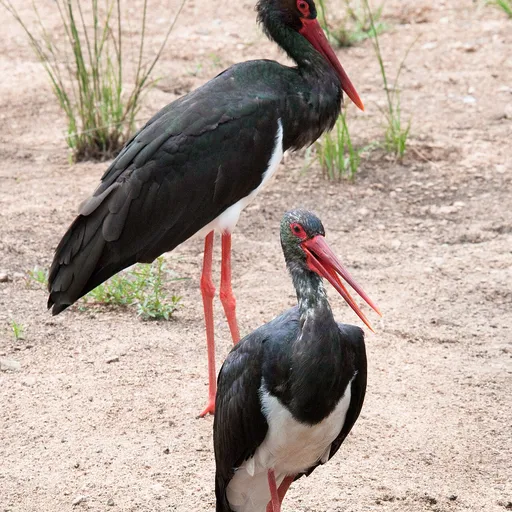
Black Stork
Ciconia nigra
Least Concern
Listen
XC1143448 · Tanguy Loïs · Monfragüe, Caceres, Extremadura, Spain · CC BY-SA 4.0
Overview
The black stork (Ciconia nigra) is a large, long-distance migratory bird characterised by its mostly black plumage with a purplish green sheen and white underparts. Widespread but uncommon, it breeds across Europe and Asia before migrating to tropical Africa and the Indian subcontinent, where it is considered a species of least concern.
Identification
- Adults are 95 to 100 cm long with a 145 to 155 cm wingspan, featuring mainly black plumage with a purplish green sheen, white lower breast, belly, and armpits, and long red legs and beak.
- It possesses a long, straight, pointed red beak and brown irises with bare red skin around the eyes, while juveniles have greyish green legs and beaks.
- In flight, it keeps its neck outstretched and can be recognised by its broad wings; on the ground, it walks slowly and steadily.
- Its main call is described as chee leee, sounding like a loud inhalation, and it may produce a hissing warning or wheezy squealing calls during displays.
Habitat
Found across Europe, the Palearctic to the Pacific, and Sub-Saharan Africa, it prefers wooded marshy wetlands, rivers, and freshwater lakes, often inhabiting areas with interspersed coniferous or broadleaved woodlands. It avoids close contact with people and nests in large deciduous trees, conifers, or on cliffs and boulders in mountainous regions, usually at least one kilometre apart.
Diet
The black stork feeds on amphibians, small fish, and insects, foraging by wading slowly in shallow water to stalk its prey. It is a wary and shy species that generally forages singly or in pairs.
Did you know?
During migration, the bird avoids crossing the broad Mediterranean Sea and instead detours via narrow straits such as Gibraltar, Sicily, or the Levant because thermals, which aid its long-distance soaring, only form over land.
Sources
- Wikipedia · CC BY-SA 4.0
- Wikidata · CC0 1.0