
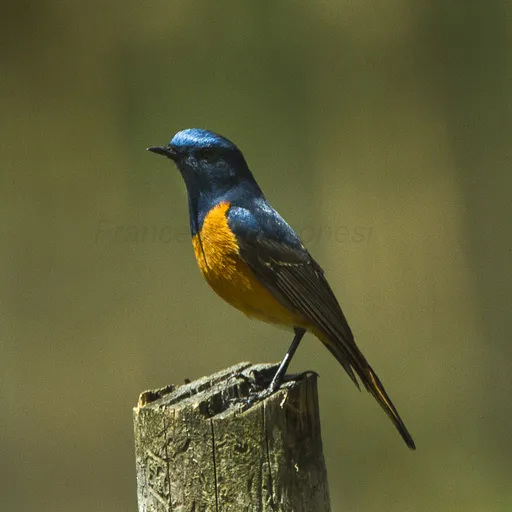
Blue-fronted Robin
Cinclidium frontale
Least Concern
Overview
The blue-fronted robin (Cinclidium frontale) is a species of bird in the family Muscicapidae and the only member of the monotypic genus Cinclidium. It is classified as Least Concern on the IUCN Red List, with a stable population trend, although it is noted as uncommon in parts of its range.
Identification
- Males possess a sapphire blue head, dark blue body, brown back, and yellow-orange underparts, while females have an olive-brown head and body with pale underparts.
- Individuals measure 18–20 cm in length and weigh approximately 25–26 g, featuring a small black bill and grey legs.
- Both sexes lack white markings on the tail, a key distinction from the similar white-tailed robin.
- Vocalisations consist of short whistle-like notes, typically comprising three to four brief sounds given in quick succession with variations in pitch and intensity.
Habitat
This species inhabits temperate forests, including dense bamboo and evergreen vegetation, primarily at mid- to high elevations between 800 and 3000 metres. Its range encompasses Bhutan, China, Northeast India, Laos, Thailand, Vietnam, and possibly Nepal, where it remains non-migratory but may descend to lower elevations in winter.
Diet
The blue-fronted robin forages in low vegetation, such as bamboo, and on the ground. It feeds primarily on small ground insects.
Did you know?
The species is the only member of its genus, Cinclidium, making it monotypic within its taxonomic group.
Sources
- Wikipedia · CC BY-SA 4.0
- Wikidata · CC0 1.0