
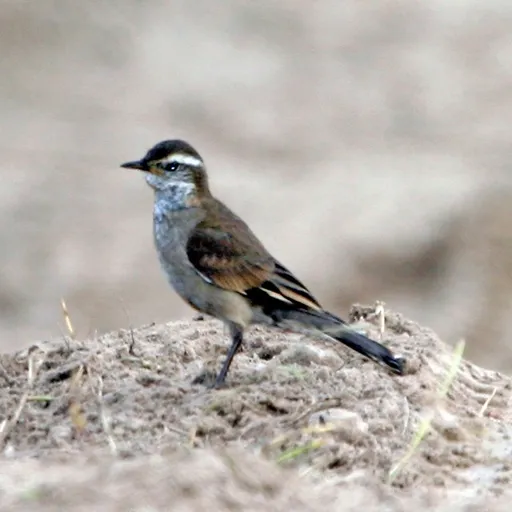
Buff-winged Cinclodes
Cinclodes fuscus
Least Concern
Overview
The buff-winged cinclodes (Cinclodes fuscus) is a small bird belonging to the ovenbird family Furnariidae. It is found across parts of South America, including Argentina, Brazil, Chile, Paraguay, and Uruguay, and is classified as a species of Least Concern.
Identification
- Small bird measuring 15 to 19.4 cm in length with a shortish bill and blackish to dark brownish legs.
- Adults feature a light buffish white supercilium, dark grey-brown ear coverts with pale streaks, and a bright white malar area that flares rearward.
- Upperparts are dark brown with dark wing coverts edged in buff, while the throat is white with thin dark scallops and the breast is dull pale brown with faint buff streaks.
- Song consists of a short, fast, dry trill lasting approximately two seconds, often introduced by call notes such as a sharp 'pfip' or high-pitched tinkling notes.
Habitat
This species inhabits a variety of open habitats, predominantly grassy areas such as páramo, puna, and temperate grasslands, as well as arid montane scrublands and Patagonian steppes. It is usually found near water sources like bogs and streams and is commonly seen around human habitations, occurring from sea level up to 3,000 m in elevation.
Diet
The buff-winged cinclodes feeds on a wide variety of invertebrates, including many insects and some molluscs, as well as seeds. It forages singly or in pairs by hopping and running on the ground, probing and gleaning from wet and dry ground, rocks, beach debris, grass, dung, and shallow water.
Did you know?
Males perform a distinctive wing-flapping display from a perch while singing to attract mates. The species is monogamous and often constructs its nest inside a burrow excavated in an earth bank, a crevice among rocks, or even a hole in a human structure's wall.
Sources
- Wikipedia · CC BY-SA 4.0
- Wikidata · CC0 1.0