
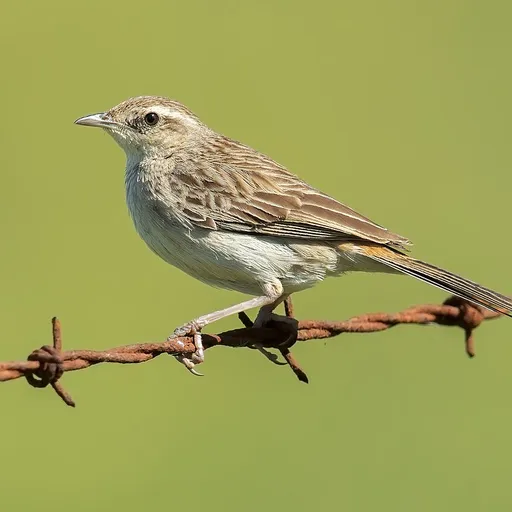
Rufous Songlark
Cincloramphus mathewsi
Least Concern
Overview
The rufous songlark (Cincloramphus mathewsi) is a passerine songbird endemic to Australia. Known for its drab appearance, it belongs to the family Locustellidae and is a common species across mainland Australia, particularly in New South Wales, Queensland, and Western Australia.
Identification
- Medium brown passerine with a pattern of streaks on its feathers, described as drab and vaguely larklike.
- Features a dark line through the eye, a pale eyebrow, pale underparts, and a distinct rufous upper tail and rump.
- Males measure approximately 19 cm in length, while females are smaller at around 16 cm.
- Recognisable by its lively, distinctive 'twitchy tweedle' song heard almost continuously during the breeding season.
Habitat
This species inhabits grasslands, grassy open woodlands, agricultural areas, and mulga. It is common across mainland Australia but rare in Tasmania and uncommon in the northern Top End. The bird migrates south during the summer to breed, making it most visible in the warmer months.
Diet
The rufous songlark hunts close to the ground for insects and other small arthropods. It is frequently found in human-populated agricultural and grassland areas where it forages for these invertebrates.
Did you know?
The female builds the deep grass nest, incubates the eggs, and raises the fledglings entirely on her own without assistance from the male. Additionally, because it often lives in human-populated areas, it sometimes ends up as road kill.
Sources
- Wikipedia · CC BY-SA 4.0
- Wikidata · CC0 1.0