
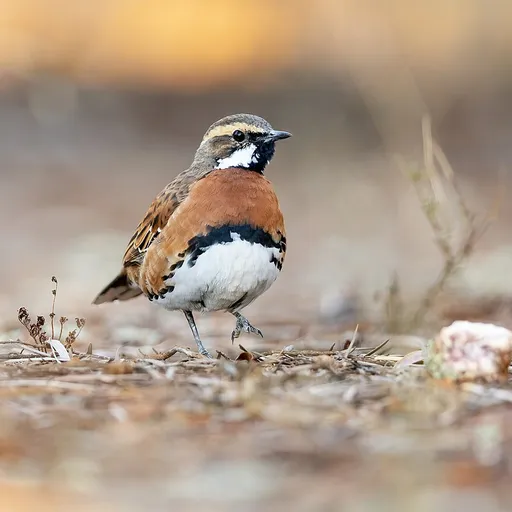
Chestnut-breasted Quail-thrush
Cinclosoma castaneothorax
Least Concern
Overview
The chestnut-breasted quail-thrush (Cinclosoma castaneothorax) is a small endemic Australian bird classified as Least Concern on the IUCN Red List. It predominantly inhabits the semi-arid deserts of north-western New South Wales and south-western Queensland, where it has evolved camouflaged plumage through a leapfrog distribution pattern across the continent.
Identification
- Males possess a glossy black throat and a rich rust-red breast band edged with black, contrasting with a buff eyebrow, deep rust-red rump and back, and a black underside.
- Females feature an orange-buff throat and malar region matching the eyebrow, with a pale brown breast that merges into dull cinnamon flanks, an olive-brown underside, and a reddish-brown rump with indistinct darker streaks.
- The common call consists of a piping whistle of two and three short notes, which is not produced by the female.
- Alarm calls comprise one or two insect-like noises resembling the call of the Myzomela nigra and are made by both sexes.
Habitat
Found in north-western New South Wales and south-western Queensland, this species occupies semi-arid zones characterised by sparse woody shrubs, herbaceous vegetation and hummock grasses. It is an endemic species restricted to these desert regions in Australia.
Did you know?
All nest attendees, including hatchlings, render themselves motionless in the presence of predators such as crows and wedge-tailed eagles. The species also exhibits aggressive behaviour by chasing away other birds, including crested and grey-crowned babblers, from the nest site.
Sources
- Wikipedia · CC BY-SA 4.0
- Wikidata · CC0 1.0