
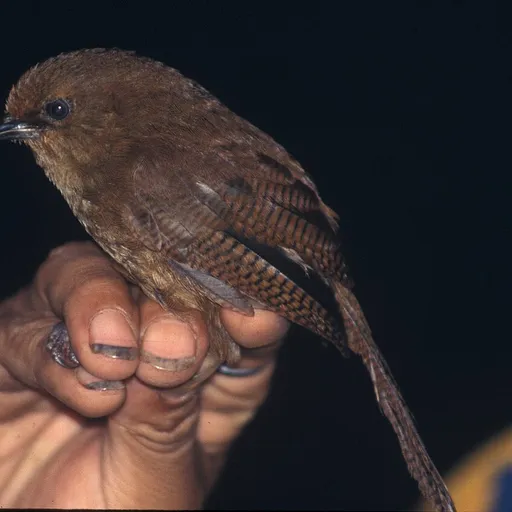
Sepia-brown Wren
Cinnycerthia olivascens
Least Concern
Listen
XC242408 · Niels Krabbe · Napo: 3.5 km SE Cosanga, Ecuador · CC BY-SA 4.0
Overview
The sepia-brown wren, also known as Sharpe's wren, is a species of bird in the family Troglodytidae found in South America. It is currently assessed as Least Concern by the IUCN, though its population is suspected to be declining due to habitat destruction and fragmentation.
Identification
- Length of 16 cm with males averaging 25.9 g and females 23 g.
- General plumage is shades of brown, with the nominate subspecies featuring a grayish brown crown, reddish brown back and rump, and a chestnut tail with blackish bars.
- Variable white on the face in nominate adults, while the C. o. bogotensis subspecies is darker overall with no facial white.
- Song is complex and variable, consisting of musical phrases with changing stress, while the call is a soft, low 'wurt'.
Habitat
This species inhabits the interior and edges of wet mossy forest and cloudforest in the Andes. Its range extends from the central and western Andes of Colombia south through Ecuador into extreme northern Peru, with one subspecies restricted to the western slope of Colombia's Eastern Andes. Elevation generally ranges between 1,500 and 3,100 m, but it can be found as low as 900 m on the Pacific slope in Colombia.
Diet
The sepia-brown wren forages on and near the ground in dense vegetation, often in flocks of up to 10 individuals. Its diet consists of invertebrates, including insects and their larvae, snails, and earthworms.
Did you know?
This species is a cooperative breeder where a breeding pair is joined by up to five other individuals who share a roost nest. The breeding pair lays eggs in a separate, bulky ball-shaped nest with a down-facing tubular entrance, constructed from rootlets, moss, and bamboo leaves.
Sources
- Wikipedia · CC BY-SA 4.0
- Wikidata · CC0 1.0