
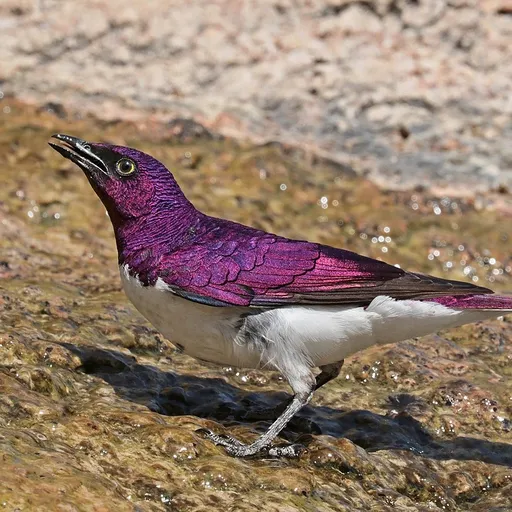
Violet-backed Starling
Cinnyricinclus leucogaster
Least Concern
Listen
XC605466 · paulo kivuyo · kikatiti, Meru, Arusha Region, Tanzania · CC BY-SA 4.0
Overview
The violet-backed starling, also known as the plum-coloured or amethyst starling, is a relatively small starling and the only member of the genus Cinnyricinclus. This strongly sexually dimorphic species is widely distributed across mainland sub-Saharan Africa and is classified as Least Concern on the IUCN Red List.
Identification
- Males feature an iridescent violet head and back contrasting with pure white underparts, whereas females resemble thrushes with brown, boldly-streaked upper parts and white, heavily-streaked underparts.
- Adults reach a length of about 18 cm, and both sexes possess yellow irises, black bills, and black legs.
- The bird is rarely seen on the ground, instead remaining in trees and other locations away from the ground.
Habitat
Found in open woodland, gallery forests, forest verges, and clearings throughout Sub-Saharan Africa, excluding the dense rainforest of the Congo Basin and arid parts of southwestern Africa. Its range extends from Senegal and Gambia to Ethiopia, Kenya, and Tanzania, with specific populations in the Arabian Peninsula and southern Africa. In areas like the Chyulu Hills of Kenya, it can occur at altitudes up to 2,100 m.
Diet
The diet consists of fruits, seeds, and arthropods, with the bird largely feeding in the canopy and seldom foraging on the ground. It sometimes hawks for insects in a manner similar to flycatchers.
Did you know?
Nests are usually located in a crevice in a tree within a few metres of the ground and are constructed using green leaves and dung. The female incubates a clutch of two to four pale blue eggs with reddish-brown spots for 12–14 days, after which the male helps feed the chicks until they fledge after about 21 days.
Sources
- Wikipedia · CC BY-SA 4.0
- Wikidata · CC0 1.0