
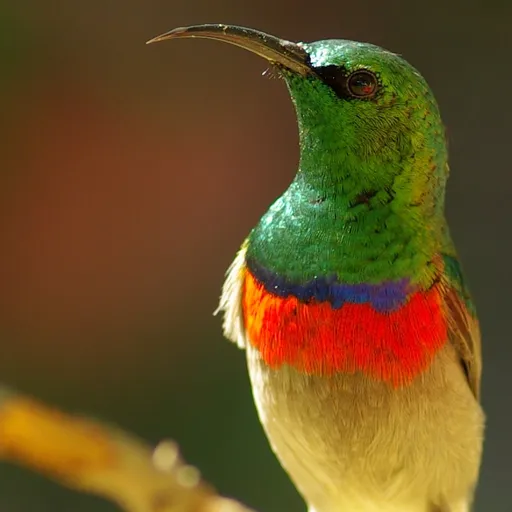
Southern Double-collared Sunbird
Cinnyris chalybeus
Least Concern
Overview
The southern double-collared sunbird, also known as the lesser double-collared sunbird (Cinnyris chalybeus), is a small passerine bird that breeds in southern Africa. It is primarily resident but exhibits partial migratory behaviour in the north-east of its range.
Identification
- Adult males feature a glossy metallic green head, throat, upper breast, and back, with a brilliant red chest band separated from the green by a narrow metallic blue band.
- Males display yellow feather tufts on the shoulders and possess a long, decurved bill, black legs and feet, and dark brown eyes.
- Females and juveniles have brown upperparts and yellowish-grey underparts, with females appearing greyer below than orange-breasted sunbirds and darker than dusky sunbirds.
- The call is a hard 'chee-chee', and the song consists of a high-pitched jumble of tinkling notes that rise and fall in pitch and tempo for three to five seconds or more.
Habitat
This species is common in gardens, fynbos, forests, and coastal scrub across southern Africa. It breeds from April to December, depending on the region, constructing a closed oval nest from grass, lichen, and plant material bound with spider webs, which features a side entrance sometimes with a porch.
Diet
The bird lives mainly on nectar from flowers but also consumes some fruit, and insects and spiders, particularly when feeding its young. It can hover to extract nectar like a hummingbird but usually perches to feed for most of the time.
Did you know?
While it can hover to feed like a hummingbird, it usually perches to take nectar, and its nest is a closed oval bound together with spider webs.
Sources
- Wikipedia · CC BY-SA 4.0
- Wikidata · CC0 1.0