
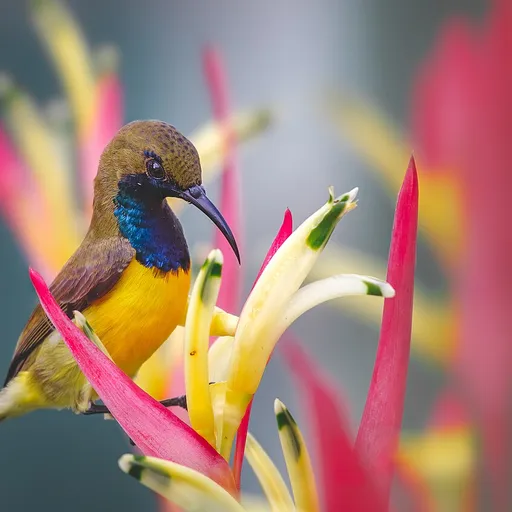
Garden Sunbird
Cinnyris jugularis
Least Concern
Overview
The garden sunbird (Cinnyris jugularis), formerly known as the olive-backed sunbird, is a small passerine in the family Nectariniidae. It is found throughout the Philippine islands, excluding the Palawan group, where it has successfully adapted to human environments.
Identification
- A small bird, 10–11.4 cm in length, with olive-green plumage on the wings and back and a bright yellow chest.
- Possesses a long, downward-curved black bill and black legs.
- Males display dark, iridescent areas around the eyes, neck, throat, and breast with yellow pectoral tufts, while females show a greenish olive upper body with a pale-yellowish stripe above the eyes.
- The male nominate subspecies features black wing feathers with green edges and a black tail with white tips, whereas females have black and white tail markings.
Habitat
This species inhabits forests, shrublands, grasslands, and artificial habitats across the Philippines. It is notably adaptable to densely populated areas, often building nests within human settlements, and is absent only from the Palawan archipelago.
Diet
Primarily nectarivorous, the garden sunbird uses its curved bill to feed on nectar, usually perching rather than hovering. It also consumes insects and spiders, particularly when feeding its chicks.
Did you know?
The female constructs an elaborate hanging oval pouch nest with a sheltered side opening and often a dangling "beard", built from a mix of grass, moss, lichens, vegetable fibres, and spider webs.
Sources
- Wikipedia · CC BY-SA 4.0
- Wikidata · CC0 1.0