
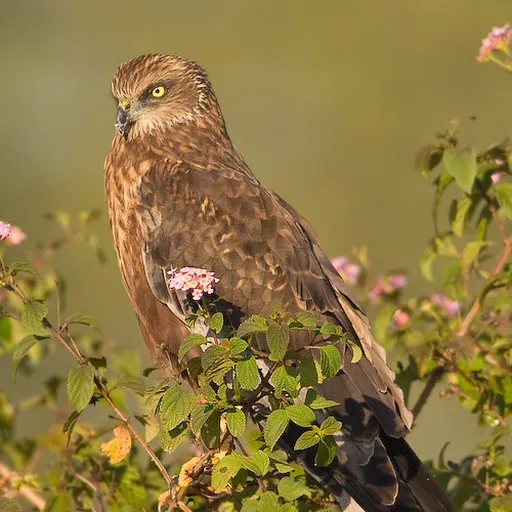
Western Marsh Harrier
Circus aeruginosus
Least Concern
Listen
XC1100625 · Sonothèque ADVL · Genêts, Manche, Normandie, France · CC0 1.0
Overview
The Circus aeruginosus, also known as the Eurasian marsh harrier, is a large, bulky bird of prey native to temperate and subtropical western Eurasia and adjacent Africa. It is the most widespread of the marsh harriers, with a range that extends from Europe to central Asia, though it is absent from mountainous regions and subarctic Scandinavia.
Identification
- Size and build: Large and bulky, measuring 48–56 cm in length with a wingspan of 115–130 cm; noticeably larger than other European harriers.
- Male plumage: Predominantly reddish-brown with yellowish streaks on the breast and pale greyish-yellow head; appears three-coloured in flight with brown, grey, and black elements.
- Female and juvenile plumage: Almost entirely chocolate-brown with a distinctively lighter yellowish head and throat; females lack the grey tail and wing patches seen in males.
- Field marks: Yellow legs, feet, and irides; the bill is black. In flight, the male displays a shallow V-shape with dangling legs.
Habitat
Strongly associated with wetland areas, particularly those rich in common reed (Phragmites australis), though it also occupies open habitats such as farmland and grassland bordering marshes. Its breeding range spans Europe, northwestern Africa, and central Asia, while wintering grounds include the Sahel, the Nile basin, and parts of South Asia. The species is territorial during the breeding season and generally less social than other harriers, except in specific roosting locations.
Diet
Hunts in typical harrier fashion by gliding low over flat, open ground with wings held in a shallow V-shape and legs dangling. Its diet consists of small mammals, small birds, insects, reptiles, and frogs.
Did you know?
While generally solitary, up to 100 individuals may roost together at specific sites like Keoladeo National Park in India, often using floating carpets of water hyacinth to gain early warning of predators. A rare hypermelanic morph, most common in the east of the range, can appear entirely black in flight when juvenile.
Sources
- Wikipedia · CC BY-SA 4.0
- Wikidata · CC0 1.0