
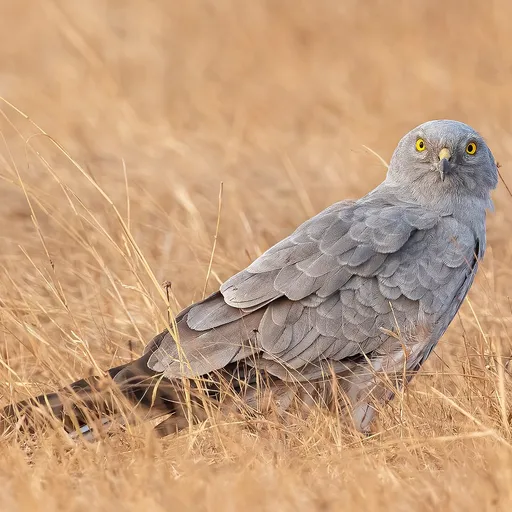
Montagu's Harrier
Circus pygargus
Least Concern
Overview
Montagu's harrier (Circus pygargus) is a species of harrier and a bird of prey in the family Accipitridae. This migratory raptor breeds in large open areas of the Palearctic and overwinters in Africa, the Indian subcontinent, and parts of the Arabian Peninsula. Its common name commemorates the British naturalist George Montagu.
Identification
- Adult males feature overall pale grey plumage with black wingtips, characteristic black bands along the secondaries, and rusty streaks on the belly and flanks.
- Adult females have pale yellow-brown underparts with longitudinal stripes and spotted wing coverts, contrasted by uniform dark brown upper parts and white upper tail coverts.
- Flight is particularly smooth and buoyant with powerful, elegant wingbeats, typically holding wings in a marked positive dihedral while searching low over the ground.
- A melanistic form occurs regularly, with males appearing black-headed and brownish-black above, and females entirely chocolate brown except for grey flight feathers.
Habitat
Montagu's harrier inhabits a middle-latitude band of temperate, Mediterranean, and boreal climates, favouring lowland areas such as broad river valleys, plains, and levels bordering lakes and the sea. It breeds in open areas including wetlands, heaths, dunes, moors, steppe, and shrublands, though it may utilise agricultural farmlands like grasslands and cereal crops when other habitats are unavailable. The species avoids densely settled areas and is highly susceptible to disturbance.
Diet
The diet consists mainly of small rodents, small birds, bird eggs, reptiles, and large insects, with specific prey varying by region such as ground squirrels in the north and reptiles in southern Europe. Foraging involves flying along fixed routes at low heights and constant speeds, often following vegetation edges to catch prey by surprise after a short stoop. During the breeding season, males provision females and young by dropping prey in the air as the female flies underneath.
Did you know?
Semi-colonial nesting behaviour, where as many as 30 nests may be located within 10 metres of each other, arises from the need to provide better defence against predators rather than a shortage of nesting sites.
Sources
- Wikipedia · CC BY-SA 4.0
- Wikidata · CC0 1.0