
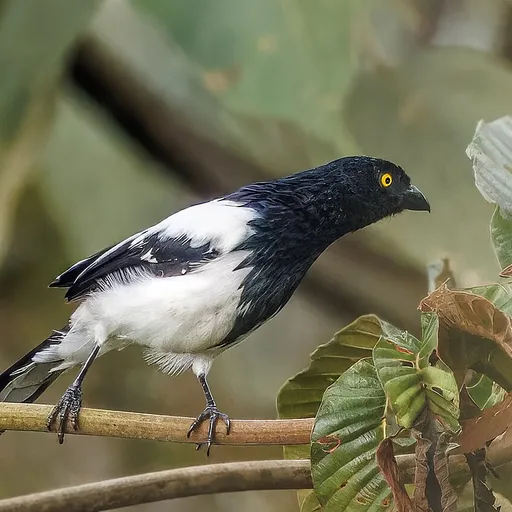
Magpie Tanager
Cissopis leverianus
Least Concern
Listen
XC242423 · Niels Krabbe · Morona-Santiago: e-slope Cord. de Cutucú: Uuntsuants, Ecuador · CC BY-SA 4.0
Overview
The magpie tanager (Cissopis leverianus) is a South American species of tanager and the sole member of the monotypic genus Cissopis. As its common name suggests, this blue-black and white bird is superficially reminiscent of a European magpie. It is classified as Least Concern on the IUCN Red List.
Identification
- Plumage is blue-black and white, offering a superficial resemblance to a European magpie.
- Measures 25–30 cm (9.8–11.8 in) in total length, with a large percentage of that length being tail, making it the longest species of tanager.
- Weighs between 69–76 g (2.4–2.7 oz).
- Frequently observed in conspicuous, noisy pairs or groups of up to ten individuals, often participating in mixed-species flocks.
- Characteristically moves its long tail up and down.
Habitat
Widespread in humid tropical and subtropical woodland, plantations, second growth, and parks in South America east of the Andes, though absent from drier regions such as the Caatinga and most of north-eastern Brazil. It primarily inhabits lowlands but can occur up to an altitude of 2,000 m (6,600 ft) on the east Andean slopes. In densely forested areas, it is found mainly in relatively open sections, such as near major rivers, and is spreading into areas opened up by deforestation.
Diet
The species eats seeds, fruits, and insects. It typically occurs in conspicuous, noisy pairs or groups and commonly takes part in mixed-species flocks.
Did you know?
The genus name Cissopis is derived from the Ancient Greek words kissa meaning "magpie" and -ōpis meaning "-faced". The specific epithet leverianus was chosen to honour the English collector Ashton Lever.
Sources
- Wikipedia · CC BY-SA 4.0
- Wikidata · CC0 1.0