
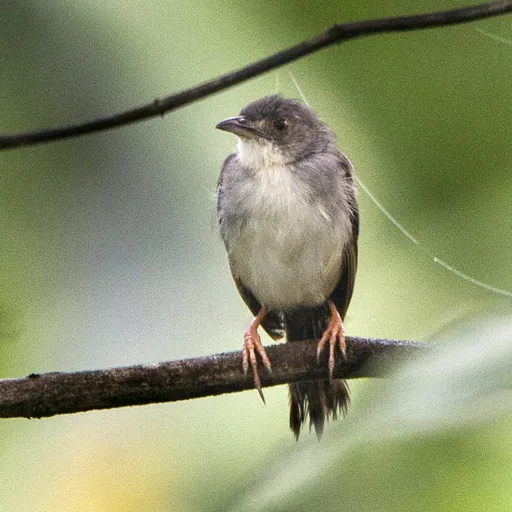
Whistling Cisticola
Cisticola lateralis
Least Concern
Overview
The whistling cisticola (Cisticola lateralis) is a mid-sized bird species belonging to the family Cisticolidae. It is native to tropical rainforests and adjacent areas across Africa. The species is classified as Least Concern by the IUCN Red List due to its large range and stable population trend.
Identification
- Body length of 13–16 cm, with males weighing 14–21 g and females 12–19 g.
- Breeding males feature grey-brown cheeks, sooty-brown underparts, a white throat, a black bill, and dull pink legs.
- Non-breeding males appear more reddish-brown with a grey breast, while females are paler with a brownish bill and a slenderer build.
- Juveniles are slender, washed yellow below, with bills that are brown with yellow bits and sometimes bright red underparts.
Habitat
Natural habitats include subtropical or tropical dry forests, dry savanna, and moist savanna. The species has a large distribution across Africa, with subspecies ranging from Senegal and Gambia to Cameroon, Central African Republic to West Kenya, and Gabon to North Angola, South DR Congo, and North Zambia.
Diet
The diet mainly consists of insects and vertebrates, including termites, beetles, grasshoppers, bugs, and spiders. These birds forage in families and groups rather than alone, extracting nutrients from vegetation on or close to the ground.
Did you know?
Males are polygamous but maintain solitary and territorial breeding periods, singing from raised perches within close eyesight of females and occasionally performing display flights. Nests are constructed from dry grass and living leaves bound together with cobwebs, often featuring side entrances and camouflaged with extra leaves.
Sources
- Wikipedia · CC BY-SA 4.0
- Wikidata · CC0 1.0