
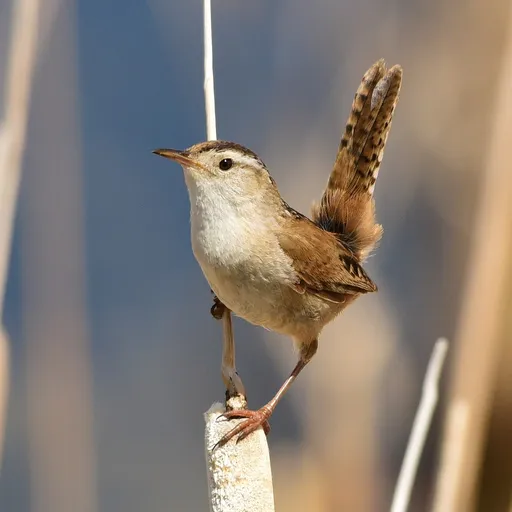
Marsh Wren
Cistothorus palustris
Least Concern
Overview
The marsh wren, Cistothorus palustris, is a small North American songbird belonging to the wren family. Formerly known as the long-billed marsh wren, it is distinguished from the sedge wren by its bill length and is classified as Least Concern on the IUCN Red List.
Identification
- Brown upperparts with a light brown belly and flanks, paired with a white throat and breast.
- Black back featuring distinct white stripes, complemented by a dark cap with a white line over the eyes.
- Possesses a short, thin bill and measures between 3.9 and 5.5 inches (9.9–14.0 cm) in length.
- The male produces a loud, gurgling song to declare territory, with western males exhibiting a more varied repertoire.
Habitat
Native to Canada, Mexico, and the United States, this species prefers marshes with tall, uniform vegetation such as cattails. Breeding occurs in the northeastern United States extending into Canada, while non-breeding populations migrate to marshes and salt marshes in the southern United States and Mexico, though some western birds remain as permanent residents.
Diet
These birds forage actively in vegetation close to the water, occasionally catching insects in flight. Their diet consists mainly of insects, including beetles, caterpillars, and ants, as well as spiders and snails, with seasonal variations in prey such as ants and wasps being more common in autumn.
Did you know?
Marsh wren eggs are notably robust, capable of withstanding pressure 2.9 times higher than expected for passerine eggs, likely as an adaptation to the males' habit of puncturing eggs and fatally pecking nestlings in nearby nests to eliminate competition.
Sources
- Wikipedia · CC BY-SA 4.0
- Wikidata · CC0 1.0